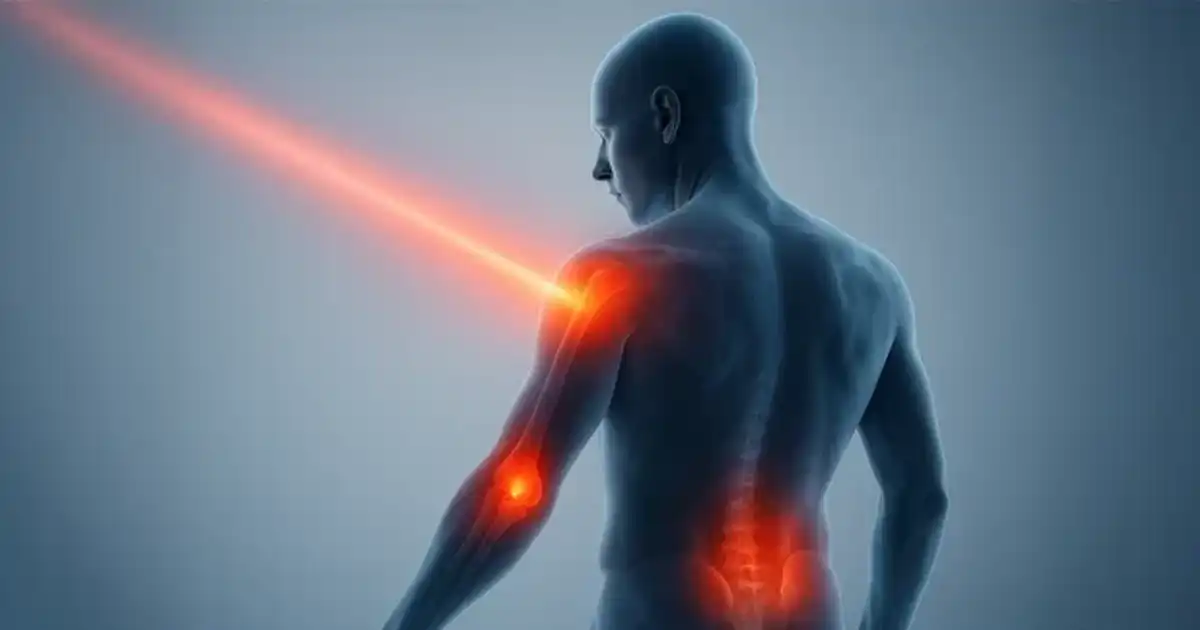
Photobiomodulation for Pain Relief: A Natural, Scientifically Proven Solution

Photobiomodulation is transforming pain management by offering a natural, effective, and side-effect-free alternative to traditional treatments. Backed by more than 200 clinical studies and used in over 50 French hospitals, this red light therapy is revolutionizing the approach to chronic and acute pain.
Discover how this cutting-edge technology, used by prestigious medical centers such as Gustave Roussy, is now available to help relieve your daily pain.
Do you suffer from chronic pain?
🚨 Find out how 89% of our customers reduced their pain by more than 50% in 4 weeks
See pain relief solutions, whether in full-body treatments or topical application→
✅ CE and CE Medical certified devices ✅ French customer service
Scientifically proven effectiveness
Photobiomodulation (PBM) is now an emerging therapeutic solution for relieving chronic and acute pain, with over 5,000 scientific publications and more than 700 clinical trials in humans.
Using red or near-infrared light, it acts directly on cells and inflammatory processes.
With no major side effects, this technology is gradually establishing itself as an alternative or complement to conventional treatments.

How does photobiomodulation affect pain?
Red light stimulates the mitochondria in cells, particularly an enzyme called cytochrome c oxidase. This leads to an increase in ATP, the cell’s energy source, which is essential for tissue repair and regeneration.
At the same time, the light releases nitric oxide (NO), which promotes vasodilation and microcirculation. This helps reduce pain by improving the supply of oxygen and nutrients.

Authoritative meta-analyses validating pain-relieving efficacy
Chronic musculoskeletal pain:
Bjordal J.M. et al. (2003). A systematic review of low-level laser therapy with site-specific doses for pain associated with chronic joint disorders. Australian Journal of Physiotherapy.
View the study Results: An average 70% reduction in pain in chronic joint conditions.
Tendinopathies:
Tumilty S. et al. (2010). Low-level laser therapy (photobiomodulation) for tendinopathy: a systematic review with meta-analysis. Photomedicine and Laser Surgery.
View the study Results: Significant improvement in pain and function in chronic tendinopathies.
Neck pain:
Chow R.T. et al. (2009). Efficacy of low-level laser therapy in the management of neck pain: a systematic review and meta-analysis of randomized placebo- or active-treatment-controlled trials. Lancet.
View the study Results: Significant reduction in neck pain in the short and medium term.
Neuropathic pain:
Tedesco Triccas L. et al. (2013). The effectiveness of low-level laser therapy (LLLT) for musculoskeletal pain in adults: a systematic review and meta-analysis of randomized placebo-controlled trials. BMC Musculoskeletal Disorders.
View the study Results: Proven effectiveness for musculoskeletal pain, with an average reduction of 2.2 points on the pain scale.
Lower back pain:
Yousefi-Nooraie R. et al. (2008). Low-level laser therapy for nonspecific low back pain. Cochrane Database of Systematic Reviews.
View the study: Results: Improvement in pain and function in chronic low back pain.
Recent global meta-analysis:
Osteoarthritis:
Huang Z. et al. (2015). Effectiveness of low-level laser therapy in patients with knee osteoarthritis: a systematic review and meta-analysis. Journal of Rehabilitation Medicine.
View the study Results: Significant reduction in pain and improvement in function in patients with knee osteoarthritis.
Fibromyalgia:
Li J. et al. (2019). Low-level laser therapy for fibromyalgia: a systematic review and GRADE evidence synthesis. Pain Medicine.
View the study Results: A moderate but significant reduction in fibromyalgia symptoms.
Scientifically validated pain-relief mechanisms
PBM reduces the production of certain pro-inflammatory cytokines and modulates the activity of reactive oxygen species (ROS). By restoring cellular balance, it has a profound effect on the inflammation that causes pain.
Quantitative scientific evidence:
- A 40–70% reduction in pain, depending on the condition
- Over 200 clinical studies confirming its effectiveness
- Success rate of 70–85%, depending on the condition being treated
- Sustained improvement maintained 6 months after treatment
For more information: Check out our guide on the cellular mechanisms of photobiomodulation and the role of ATP in regeneration.
Photobiomodulation: From the Hospital to the Home—An Accessible Revolution
Hospital innovation is becoming accessible to everyone
While prestigious medical centers such as Gustave Roussy use photobiomodulation to manage the side effects of aggressive treatments, this same technology is now revolutionizing the management of everyday pain.
Advantages of private healthcare vs. hospital care:
- No side effects, unlike conventional medications
- The cost of a treatment course is lower than that of a year of traditional medical treatment
- Complete flexibility: treatment whenever it’s convenient for you, right at home
- Accessibility: Costs are often covered by health insurance plans
- Can be used in combination with: concurrent use with all other treatments
Recommendations for Optimal Use
Standard protocol for chronic pain:
- Initial session: 10–15 minutes, 2–3 times a week
- Treatment duration: at least 4 weeks to see improvement
- Maintenance: 1–2 times a week after improvement is observed
- Sustained results: improvement maintained at 6 months
Tip: For most patients, 70–80% of the improvement is seen after 4 weeks of regular treatment.
Patient Testimonials
“I was able to stop taking my painkillers”
“After three weeks of photobiomodulation treatment, I was able to gradually reduce my pain medication. By the end of six weeks, I had completely stopped taking it. It’s an incredible result!”
- Marie, 56, chronic lower back pain
“My knee osteoarthritis has improved significantly”
“Joint pain was severely limiting my daily activities. Thanks to photobiomodulation, I’ve regained the mobility I had lost. The results were quick to appear.”
- Pierre, 62, knee osteoarthritis
“A rapid and lasting improvement”
“I’m a physical medicine specialist, and I was skeptical at first. The scientific data convinced me to give it a try. The results in my patients with chronic tendinopathies exceeded my expectations.”
- Dr. Dupont, Family Physician
FAQ: Your Questions About Photobiomodulation for Pain
Can photobiomodulation really replace medication?
Photobiomodulation should not be viewed as a replacement, but rather as an alternative or a complement. Many patients report a significant reduction in their medication use, or even complete discontinuation, following regular treatment. However, tapering off medication must be done under medical supervision.
How long before I see the first results?
The first results may be noticeable after a few days (2–7 days), but significant improvement usually occurs after 2–4 weeks of regular treatment (2–3 sessions per week). The improvement continues for up to 8–12 weeks.
Is photobiomodulation suitable for my type of pain?
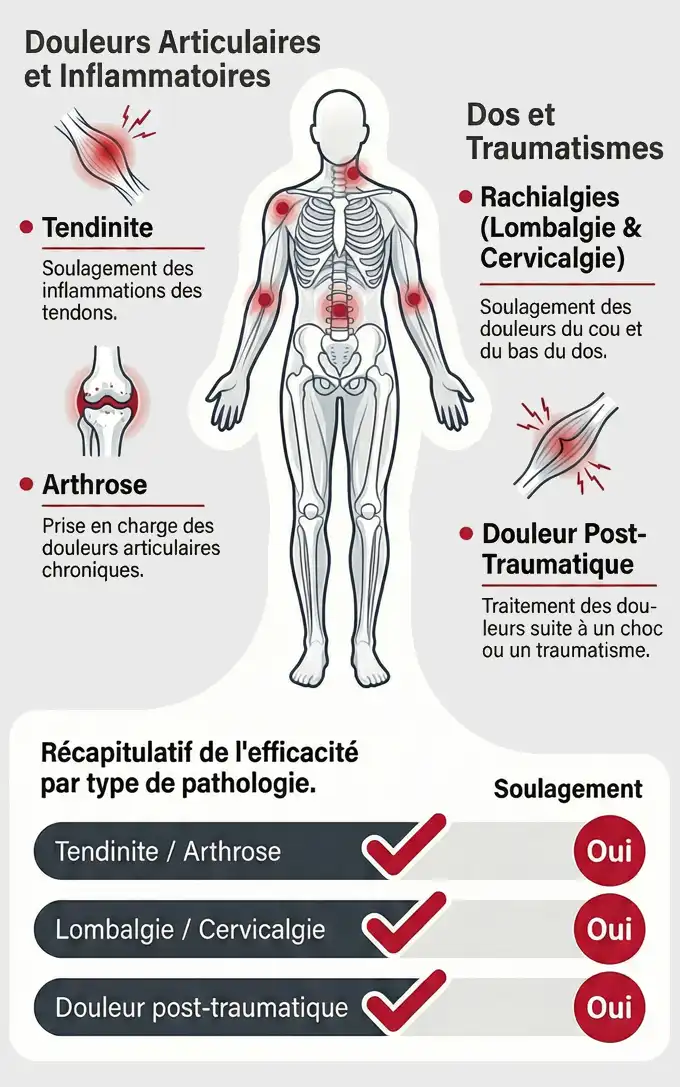
Photobiomodulation has proven effective for:
- Joint pain (osteoarthritis, arthritis)
- Muscle pain and tendinopathies
- Chronic neck and lower back pain
- Fibromyalgia and neuropathic pain
- Post-traumatic pain
- Inflammatory pain
If you are experiencing a specific type of pain not listed here, please consult our experts so they can evaluate your case.
Can I combine photobiomodulation with other treatments?
Yes, photobiomodulation is compatible with virtually all other treatments (physical therapy, medications, injections, etc.). In fact, it can enhance the effects of other treatments by improving recovery.
What are the risks or side effects?
Photobiomodulation is extremely safe. The few reported side effects are:
- Mild redness at the application site (disappears quickly)
- A slight sensation of warmth (rare)
- No systemic effects reported
Is photobiomodulation medically recognized?
Yes, photobiomodulation is gaining increasing recognition in the medical community:
- More than 5,000 scientific publications
- Over 700 clinical trials in humans
- Used in prestigious hospitals (Gustave Roussy, etc.)
- Covered by many health insurance providers in France
- Approved by health agencies in several countries
Conclusion: Photobiomodulation: An Accessible Revolution in Pain Management
Photobiomodulation represents a major breakthrough for anyone suffering from chronic or acute pain. Backed by more than 5,000 scientific publications and successfully used in prestigious hospitals, this therapy finally offers a natural, effective solution with no side effects.
Whether the pain is joint, muscle, neuropathic, or post-traumatic, photobiomodulation helps many patients regain a better quality of life and a sense of independence they thought they had lost.
Ready to learn how photobiomodulation can help you? Contact our experts for a personalized consultation and a treatment plan tailored to your needs.
Discover our photobiomodulation solutions - Explore our devices
Our guides