*Nature* Takes Stock of Red Light Therapy
When *Nature* devotes ten pages to red light
*Nature* is not a wellness magazine. It is the most-cited scientific journal in the world, and it does not publish a 10-minute-long feature on a topic it considers trivial. On March 25, 2026, however, it posted a lengthy article by Lynne Peeples titled “Does red-light therapy work? Here’s what the science says,” which was reprinted on March 26 by Scientific American.
We read it cover to cover. Here's what it says, what it doesn't say, and why it's changing the conversation about photobiomodulation.
Table of Contents
- A skeptical dermatologist, a son in the hospital
- What science takes for granted
- What Light Does to Mitochondria
- The Light We Can No Longer See
- The reservations of the researchers themselves
- Frequently Asked Questions
- Key Takeaways
A skeptical dermatologist, a son in the hospital
The article opens with a personal story. In 2021, David Ozog, chief of dermatology at Henry Ford Health in Michigan, was on vacation in the Bahamas when his 18-year-old son suffered a massive stroke. A colleague from Harvard, who was working with the U.S. Department of Defense on the effects of red and near-infrared light following brain injury, advised him to give it a try. Ozog read articles until 4 a.m., ordered LED panels, and had them discreetly brought into the hospital.
His son is now walking and has resumed his studies. Ozog cannot prove that the light had anything to do with it, and *Nature* does not claim that either. What matters in this story is the dermatologist’s remark about his own previous skepticism: how could a simple light have a biological effect? Four years later, he co-signed the expert consensus that answers that question.
What science takes for granted
This is the most useful section of the report. Lynne Peeples lists the areas in which the evidence has become more solid over the past ten years:
- In 2025, more than twenty experts published a consensus review concluding that photobiomodulation is safe and effective for several types of ulcers, peripheral neuropathy, acute radiation dermatitis, and androgenetic alopecia.
- The FDA has approved a red-light device for the treatment of dry age-related macular degeneration.
- Since 2020, red light therapy for the mouth has been included in clinical guidelines for the prevention and treatment of oral mucositis associated with cancer treatments.
On this last point, Ozog regrets that the method remains so underutilized: he estimates that about 10% of treatment centers use it, even though it is simple, safe, and inexpensive. This is exactly the observation we made in the France 24 report on French hospitals.
Beyond these findings, the article cites clinical trials on muscle recovery in athletes, symptoms of depression, pain associated with osteoarthritis and fibromyalgia, and a small Brazilian study from 2022 in which patients with severe COVID-19 were discharged from the hospital nearly four days earlier. These results are presented as promising, not as established. This nuance is maintained throughout the text, and we are reproducing it here exactly as it appears.
What Light Does to Mitochondria
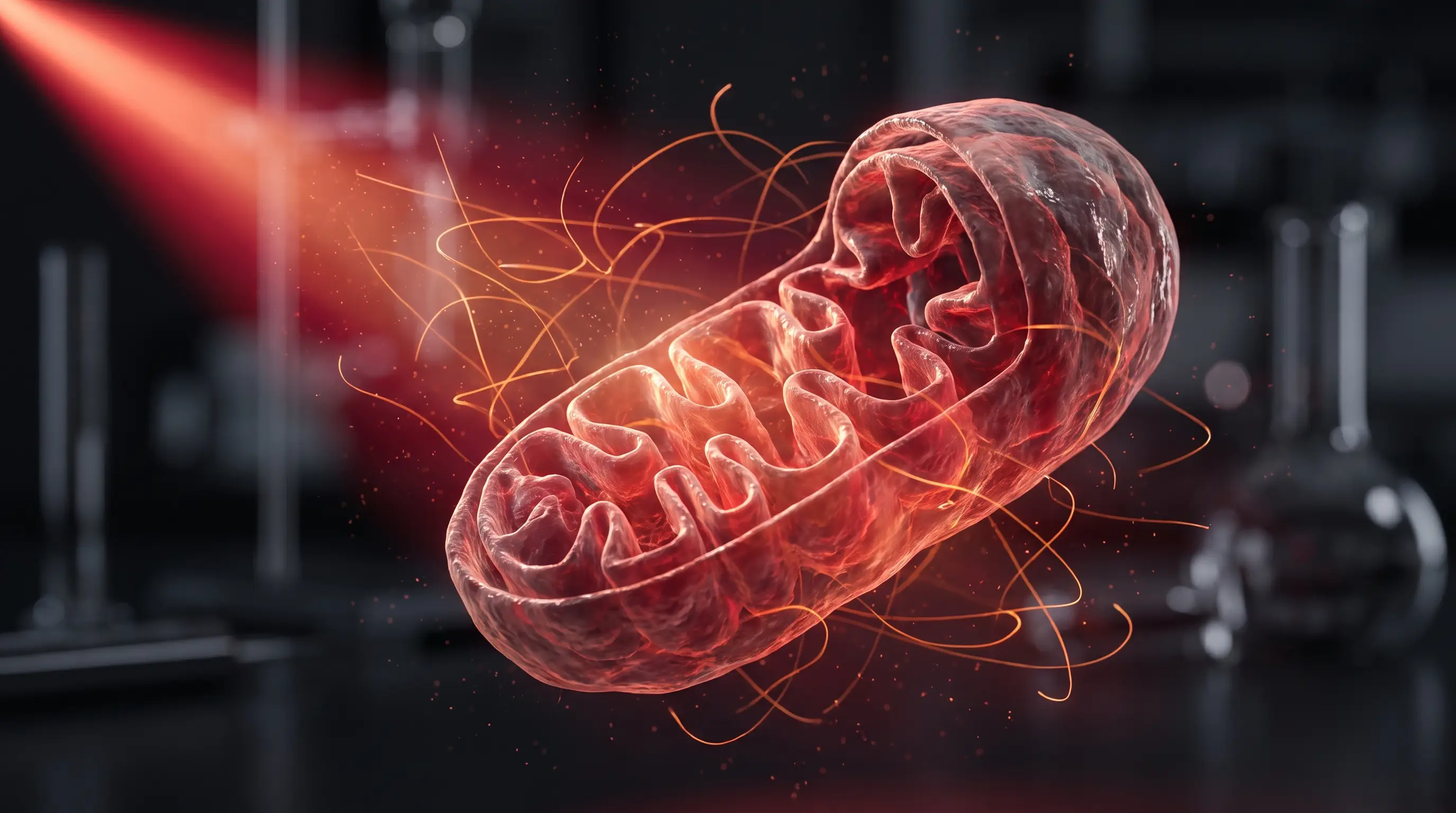
Why would red light have an effect on a cell? *Nature* summarizes the prevailing hypothesis. Wavelengths between 600 and 700 nm, and then between 760 and 940 nm, are absorbed by cytochrome c oxidase, an enzyme in the mitochondrial respiratory chain. This absorption is thought to push the chain toward a more active state, leading to increased production of ATP—the cell’s fuel—followed by improved blood circulation and modulation of inflammation and oxidative stress.
The article makes an observation that we believe is important: when cells are healthy, light has little effect. It is in situations of disease or metabolic stress—when mitochondria are dysfunctional—that the effect seems most pronounced. This could explain why results vary so much from one study to another. Praveen Arany, of the University at Buffalo, also points out that the mitochondrial explanation does not tell the whole story: even with a mitochondrial inhibitor, a therapeutic response persists.
Two more exploratory avenues are mentioned. A trial sponsored by Columbia University will test brief exposure to red light on embryos undergoing in vitro fertilization. And Glen Jeffery’s team at University College London observed that 15 minutes of red light applied to the back reduced blood sugar spikes after a meal, as if mitochondria were communicating from one part of the body to another. Other researchers are calling for larger studies before drawing any conclusions.
The Light We Can No Longer See
This is the part of the article that gave us the most food for thought. Humans have evolved under sunlight with a spectrum ranging from 300 to 2,500 nm. For almost our entire history, indoor lighting resembled that sunlight. Today, window glass filters out longer wavelengths to limit heat, and energy-efficient LEDs concentrate their emission within a narrow band of the visible spectrum. An incandescent light bulb emitted about 90 percent of its energy as infrared light; it has disappeared. And we spend nearly 90 percent of our time indoors.
Several researchers cited by *Nature* are wondering whether this prolonged deprivation has biological consequences. A study published this year in a controlled office setting suggests that daylight and artificial lighting enriched with near-infrared light improve markers of mood, heart rate variability, and glucose regulation. A January preprint, based on data from more than 400,000 adults, links higher exposure to sunlight with longer life expectancy, even after accounting for skin cancer.
We do not draw any definitive conclusions from this research. But the idea that red and near-infrared light is not some exotic novelty—but rather a component of our environment that we have unthinkingly eliminated—deserves to be taken seriously.
The reservations of the researchers themselves
The article does not gloss over the uncertainties. The optimal wavelengths, intensities, durations, and pulse frequencies have yet to be determined for each indication. It is unclear whether age or skin color should affect the dose. Getting enough photons to pass through the human skull remains difficult, and some devices powerful enough to affect the brain will likely not be available for over-the-counter sale.
Above all, the scientists interviewed are concerned about the market. Glen Jeffery puts it bluntly: companies that promise eternal life give a serious field of research a bad name. Juanita Anders, a researcher in Bethesda, notes that many of the products being tested do not deliver a therapeutic dose. Elke Buschbeck, a biologist in Cincinnati, admits that all of this makes her nervous: we don’t yet fully understand what we’re doing. Her advice is the simplest of all: go outside.
We share these concerns. The difference between a device that works and a gadget comes down to its specifications, not marketing. That is why we document the criteria for choosing a device rather than promising results.
Frequently Asked Questions
What does *Nature* say about the effectiveness of red light therapy?
The March 25, 2026, Nature report distinguishes between indications supported by a 2025 expert consensus (ulcers, peripheral neuropathy, acute radiodermatitis, androgenetic alopecia), those covered by clinical guidelines (oral mucositis) or FDA approval (dry AMD), and those still in the exploratory phase (athletic recovery, depression, Parkinson’s disease, metabolism).
How does red light affect cells?
The prevailing hypothesis described by *Nature* is that cytochrome c oxidase in the mitochondria absorbs red and near-infrared wavelengths, leading to increased ATP production, improved circulation, and modulation of inflammation. The effect is believed to be more pronounced in stressed or diseased cells than in healthy cells.
Are red-light devices sold online reliable?
Not all of them. Researchers cited by *Nature* note that many consumer products do not deliver a therapeutic dose due to inadequate wavelength or irradiance. They are calling for independent testing and clear standards. Verifying a device’s technical specifications is more important than its claims.
Key Takeaways
A leading journal took the time to review the evidence, and its verdict is nuanced but clear: photobiomodulation is no longer a fringe field. Some indications are well-established, others are making progress, many still need to be documented, and the market is moving faster than science. This is an honest assessment of the field in which we work.
The point that will stay with us the longest is that of lost light. If our buildings have eliminated red and infrared light from our daily lives, photobiomodulation may not be an addition, but rather a restoration.
The original article is freely available on nature.com and scientificamerican.com.
Source: Lynne Peeples, “Does red-light therapy work? Here’s what the science says,” Nature, March 25, 2026, republished by Scientific American on March 26, 2026. This article is a summary; it does not constitute medical advice. Photobiomodulation is not a substitute for prescribed treatment. Consult a healthcare professional.
See also
Our News
Similar articles, tips, and discoveries