Photobiomodulation and chemotherapy: the study that restores memory

Photobiomodulation and Memory Disorders After Chemotherapy: A Study by the Valenciennes University Hospital Offers Hope
Key points: At the Valenciennes Hospital Center, a pilot clinical study evaluated transcranial photobiomodulation (tPBM) in female patients suffering from cognitive impairment following chemotherapy, known as “chemobrain.” Results: 93.5% of the patients showed improved cognitive performance, and nearlyone in three regained normal memory function—without any medication and without any adverse effects. The device used was the Vielight Duo 4 headset in Gamma mode—the device Bioledtherapy in France by Bioledtherapy .
"Chemobrain": A Long-Neglected Side Effect
After undergoing chemotherapy for cancer, many patients develop problems with memory, concentration, and attention. This phenomenon, known as “chemobrain” or chemotherapy-related cognitive impairment, can have a lasting impact on the daily lives of cancer survivors. Sometimes these symptoms subside on their own; sometimes they persist, and to date, there is no medication that effectively treats them.
It is precisely this gap in treatment options that a team at the Valenciennes Hospital Center has decided to explore, using a non-pharmacological technique: photobiomodulation.
What is transcranial photobiomodulation?
Photobiomodulation (PBM) involves exposing tissues to red and near-infrared light at specific wavelengths. This light is absorbed by the mitochondria in cells—the body’s “powerhouses”—and stimulates their production of energy (ATP), promoting cellular repair and proper function.
When applied to the skull, this is known as transcranial photobiomodulation: the light passes through the scalp and bone to reach areas of the brain. The technique is noninvasive, painless, and has no known side effects at the doses used. It is already recommended for preventing and treating certain side effects of cancer treatments, such as mucositis.
What the study published by the Valenciennes CHV shows
The Valenciennes team’s work was published in a peer-reviewed scientific journal, *Supportive Care in Cancer* (the official journal of the MASCC), in January 2026. Here are the key findings of this pilot study:
- The study included 31 women with post-chemotherapy cognitive impairment (mean age 52 years).
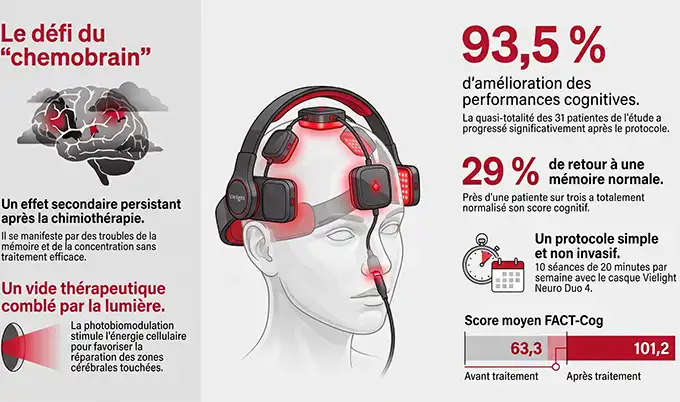
- Each patient underwent at least 10 sessions of transcranial photobiomodulation, at a rate ofone 20-minute session per week.
- Le score cognitif moyen (FACT-Cog) est passé de 63,3 avant traitement à 101,2 après (p < 0,001) - une amélioration statistiquement très significative.
- 29 out of 31 patients (93.5%) showed improved cognitive function.
- Nine patients (29%) saw their cognitive scores return to normal.
In addition to this cohort, several dozen other patients have since been treated using this technique at the center. The authors’ conclusion is clear: transcranial photobiomodulation offers real therapeutic potential for the treatment of chemobrain—an approach that is easily accessible to everyone and has no adverse effects.
"Addressing memory problems after cancer helps survivors return to a normal life and improves their quality of life." — Supportive Care Team, Valenciennes Hospital (CHV)
Headset used: the Vielight Duo 4
A key point for understanding the significance of these results: the study did not test a laboratory prototype, but rather a device that is available and can be used at home. The device used is the Vielight Duo 4 headset, used in Gamma mode (40 Hz pulsation) for 20-minute sessions.
The Vielight Duo 4 combines transcranial stimulation using diodes placed on the skull with an intranasal probe to target the brain through two complementary pathways. It is currently one of the most widely used devices for cerebral photobiomodulation in clinical research worldwide.
👉 Check out the Vielight Duo 4 headset in the Bioledtherapy store
Bioledtherapy, supplier of Vielight helmets Vielight France
Bioledtherapy proud to be the supplier of Vielight helmets Vielight France and to help make photobiomodulation accessible to both healthcare professionals and individuals.
We would like to extend our heartfelt thanks to Dr. Lidvine Godaert and Dr. Antoine Lemaire of the Valenciennes Hospital Center for their trust and for the quality of their work. Their research advances the care of cancer survivors and concretely illustrates the potential of photobiomodulation in supportive oncology. We are honored that the devices we distribute are being used in medical research of this caliber.
Frequently Asked Questions
Can photobiomodulation treat memory problems after chemotherapy?
A pilot study conducted at the Valenciennes Hospital (published in *Supportive Care in Cancer*, 2026) shows that transcranial photobiomodulation improves cognitive function in 93.5% of the patients treated and restores normal memory function in 29% of them. These results are promising but come from a pilot study; larger-scale trials are still needed to confirm the treatment’s efficacy.
What device was used in the study?
The study used the Vielight Duo 4 headset in Gamma mode (40 Hz) for 20-minute sessions once a week.
Does transcranial photobiomodulation have any side effects?
At the doses used, the technique is noninvasive, painless, and did not result in any adverse effects in the study. However, it is not a substitute for medical care: consult your healthcare provider.
How many sessions are needed?
In the study, the patients underwent at least 10 sessions of 20 minutes each, at a rate of one session per week.
Sources and References
Godaert L, Dramé M, Lemaire A. Transcranial photobiomodulation for the treatment of chemobrain: new perspectives from a pilot study. Supportive Care in Cancer. 2026;34(1):62. DOI: 10.1007/s00520-025-10280-8 (reference identified via PubMed).
This article is intended for informational purposes only and does not constitute medical advice. Photobiomodulation is not a substitute for medical treatment or follow-up care. Consult a healthcare professional with any questions regarding your specific situation.
See also
Our News
Similar articles, tips, and discoveries