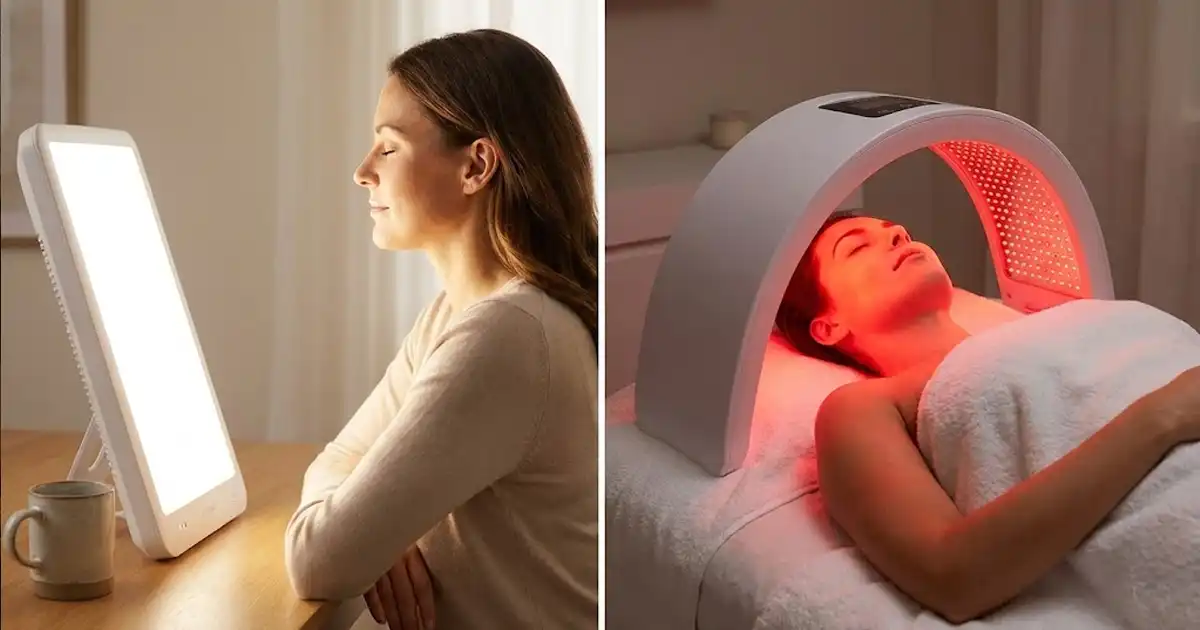
Red Light Therapy: Benefits, Risks, and Devices

Red light therapy has taken social media by storm. LED panels, masks, lamps—the promises range from flawless skin to better sleep. Behind this trend lies a solid scientific basis. It just goes by another name: photobiomodulation. Here’s what red light can do, what it can’t do, and how to use it safely.
In short: Red light therapy uses LEDs with wavelengths around 630–660 nm, often combined with near-infrared light (810–850 nm). The strongest evidence supports its use for skin health, muscle recovery, and certain types of pain. It is safe as long as you protect your eyes and follow the recommended exposure times.
What is red light therapy?
It involves exposing the skin to low-intensity red light that contains no UV rays and generates no noticeable heat. In English, this is referred to as "red light therapy." Researchers use the more precise term " photobiomodulation."
The principle is simple. Red light is absorbed by the mitochondria, the powerhouses of our cells. The cell then produces a little more energy to function and repair itself.
Red and Infrared Light: Why Combine Them?
Visible red light acts primarily on the first few millimeters of skin. It is the wavelength of choice for the face. Near-infrared light, which is invisible, penetrates deeper, reaching the muscles and joints. Most newer panels combine the two.
Be careful not to confuse these with infrared heating lamps or infrared saunas. Those primarily work by generating heat, using different wavelengths. Our article on red light and near-infrared light explains the differences in detail.
The Benefits of Red Light, Study by Study
Skin and Anti-Aging
This is the best-documented use. In a controlled trial involving 136 volunteers, 30 sessions of red light treatment improved skin tone, skin roughness, and collagen density (Wunsch and Matuschka, 2014). See also our articles on skin care and LED masks.
Muscles and Recovery
A meta-analysis of 13 randomized trials shows that red or infrared light applied before exercise improves performance and muscle recovery (Leal-Junior et al., 2015). For more information, see our article on photobiomodulation and sports.
Pain and inflammation
The results are promising for osteoarthritis, tendinitis, and certain chronic pain conditions. They vary greatly depending on the dose. See “Photobiomodulation and Pain.”
Hair and Sleep
Red LED helmets are being studied as a treatment for hair loss, with modest but real results in some cases. When it comes to sleep, the evidence is more limited. We summarize this information in our articles on hair and sleep.
For an overview, visit our page on the benefits of photobiomodulation.
Is red light dangerous?
For the skin, the risk is low. With a high-quality LED device, there is no UV radiation, no tanning, and no burns. The eyes are the real concern. In 2023, ophthalmologists reported retinal damage following repeated exposure to a red laser used to treat myopia (Liu et al., 2023). This involved a laser directed at the eye, not an LED panel on the skin. But the lesson applies to everyone: do not stare directly at the light source, and always wear the provided safety glasses.
Certain situations require medical advice: pregnancy, active cancer, photosensitive epilepsy, and photosensitizing medications. The complete list can be found in our article , “Is Photobiomodulation Dangerous?”
How to Use Red Light Effectively
- Distance: Follow the instructions; typically 15 to 30 cm per sign.
- Duration: 10 to 20 minutes per area, rarely longer.
- Frequency: 3 to 5 sessions per week for several weeks.
- Clean skin, free of lotion or makeup.
Longer doesn't mean more effective. Beyond a certain dose, the effect decreases. This is the biphasic curve.
Which red light device should you choose?
Lamp, panel, mask, or full-body booth: it all depends on the area to be treated. A lamp is sufficient for a joint. A panel covers the back or legs. A booth treats the entire body in a single session. Consider three factors before buying: wavelengths, measured irradiance, and the absence of flicker.
Our comparison of LED cabins and panels and our guide on which device to choose will help you decide. You can also check out our selection of red and infrared light devices.
Frequently Asked Questions
Does red light help you tan?
No. It does not contain UV rays and does not stimulate melanin production like the sun does.
Can you use red light every day?
Yes, for many consumer electronics devices, as long as you follow the recommended duration. Taking a break for a few days does not negate the effects.
Are red light and light therapy the same thing?
No. Light therapy uses intense white light that affects mood through the eyes. See light therapy or photobiomodulation.
Our guides