Light therapy vs. photobiomodulation: what are the differences and how do you choose?
Reviewed and approved by Dr. Jonathan Tanguy, a general practitioner at the Cormelles-le-Royal Health Center and a member of the SFPBM.
Light therapy and photobiomodulation share the same starting point—light—but they do not act in the same place or in the same way. The former communicates with the brain through the eyes; the latter communicates with cells through the skin. Understanding this distinction helps avoid many mistakes in use and allows you to choose the therapy that is truly suited to your needs.
What is light therapy?
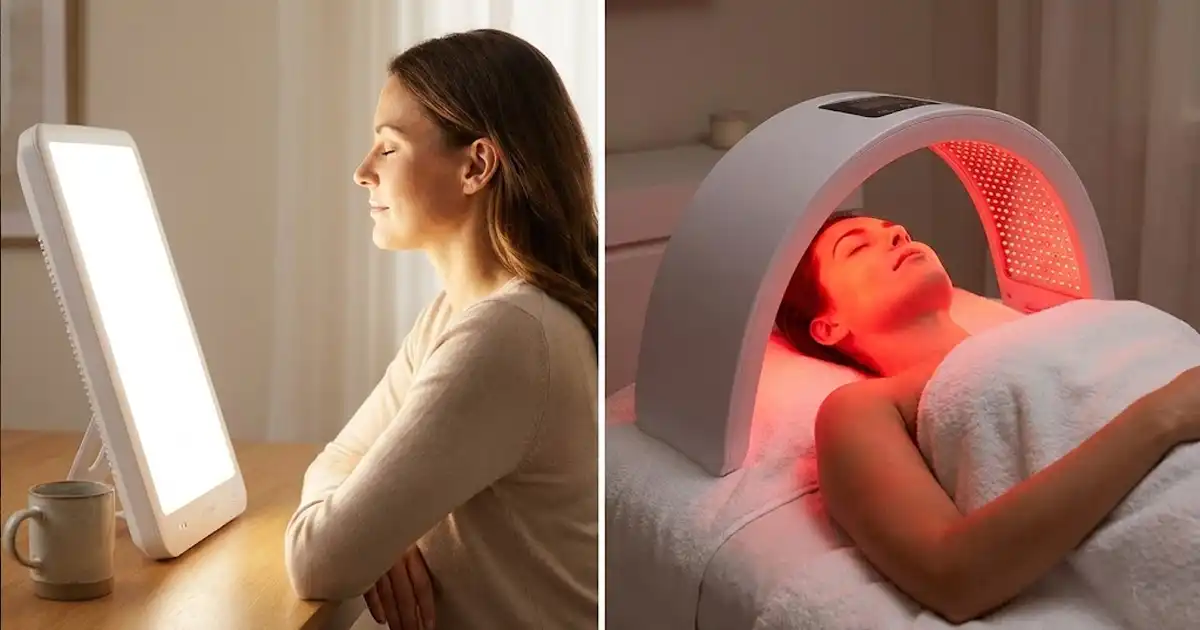
Light therapy involves exposure to high-intensity white light—typically around 10,000 lux—using a lamp placed a short distance from the face. The light is detected by the retina, which sends a signal to the suprachiasmatic nucleus, the master regulator of the body’s biological clock. This signal influences melatonin secretion, the sleep-wake cycle, and mood.
Its best-documented indication is seasonal depression. A landmark meta-analysis showed that it is as effective as antidepressants for this disorder, and benefits were also observed in certain cases of non-seasonal depression. Light therapy is also used to treat circadian rhythm disruptions (night shifts, jet lag) and certain circadian rhythm disorders.
Key point: Light therapy works through sight. Light does not “penetrate” the body; rather, it is the light signals received by the eye that reset the body’s internal clock.
What is photobiomodulation?
Photobiomodulation (PBM) uses red light (approximately 630 to 660 nm) and near-infrared light (approximately 810 to 850 nm) emitted by LEDs or low-power lasers. Unlike light therapy, this light penetrates the skin and tissues. It is absorbed by cytochrome c oxidase, an enzyme found in mitochondria, which increases cellular energy production (ATP) and modulates nitric oxide and reactive oxygen species.
The applications studied primarily involve the skin (wound healing, wrinkles, acne), pain, inflammation, muscle recovery, and hair regrowth. In dermatology, a recent review confirms a favorable safety profile and increasing use, both at home and in clinical settings.
Key point: Photobiomodulation acts within tissues at the cellular level, not on the biological clock.
Light Therapy vs. Photobiomodulation: A Comparative Chart
| Criterion | Light Therapy | Photobiomodulation |
|---|---|---|
| Type of light | White, broad-spectrum, high-intensity | Red and near-infrared, LED or laser |
| Wavelengths | Full visible spectrum (~10,000 lux) | ~630–660 nm (red) and ~810–850 nm (infrared) |
| Mechanism of action | Through the eyes (retina → brain) | Through the skin (tissue penetration) |
| Biological target | Circadian rhythm, melatonin, mood | Mitochondria, cellular energy (ATP) |
| Main Indications | Seasonal depression, disrupted circadian rhythm, jet lag | Skin, pain, inflammation, recovery, hair |
| Model Protocol | ~30 minutes in the morning in front of the lamp | A few minutes on the area to be treated |
Opposing mechanisms of action
The most significant difference lies in how light is used. In light therapy, the light does not need to enter the body; rather, it serves as a signal detected by the eye to synchronize the body’s internal clock. This is a neurohormonal mechanism.
In photobiomodulation, the opposite is true: the desired effect depends on the light’s ability to penetrate the skin and reach the cells. Red and near-infrared light are chosen precisely because they penetrate the tissues, whereas white light is blocked at the surface. This is a photochemical and cellular mechanism, described in detail on our page dedicated to the cellular mechanisms of PBM.
How do you choose between the two?
- Low mood in the winter, trouble waking up, seasonal energy slump: light therapy is the go-to solution.
- Jet lag, shift work, disrupted sleep-wake cycles: light therapy helps reset the body’s internal clock.
- Skin problems, pain, inflammation, sports recovery, hair loss: photobiomodulation is recommended.
- Relaxation and falling asleep at night: We’re turning to red light photobiomodulation, which should not be confused with morning light therapy.
If you have a medical condition (such as depression, chronic sleep disorder, or skin disease), it is essential to consult a healthcare professional before beginning.
Can we combine the two?
Yes. Since they act on different targets, light therapy and photobiomodulation can be complementary: for example, a light therapy session in the morning to regulate the circadian rhythm, and localized photobiomodulation sessions for the skin or recovery. No problematic interactions have been reported, provided that the protocols and durations specific to each method are followed.
Frequently Asked Questions
Light therapy and photobiomodulation—are they the same thing?
No. Light therapy uses intense white light that is absorbed by the eyes to regulate the body’s internal clock and mood. Photobiomodulation uses red and near-infrared light that penetrates the tissues to stimulate cells.
Which one should you choose to sleep better?
To reset a disrupted sleep-wake cycle, light therapy in the morning can be helpful. To promote relaxation in the evening, red light photobiomodulation is recommended. If you have persistent insomnia, consult a healthcare professional.
Is red light a form of light therapy?
No. Conventional light therapy uses high-intensity white light. Red and near-infrared light fall under the category of photobiomodulation, which acts on a cellular level rather than a circadian one.
Can we use both at the same time?
Yes, they complement each other because they target different mechanisms. You just need to follow the specific protocols for each one.
See also
- Definition of photobiomodulation
- The cellular mechanisms of PBM
- Red Light and Sleep
- red or near-infrared
Scientific sources
- Golden RN, Gaynes BN, Ekstrom RD, et al. (2005). The efficacy of light therapy in the treatment of mood disorders: a review and meta-analysis of the evidence. Am J Psychiatry. PubMed · DOI
- Lam RW, Levitt AJ, Levitan RD, et al. (2016). Efficacy of Bright Light Treatment, Fluoxetine, and the Combination in Patients With Nonseasonal Major Depressive Disorder: A Randomized Clinical Trial. JAMA Psychiatry. PubMed · DOI
- de Freitas LF, Hamblin MR (2016). Proposed Mechanisms of Photobiomodulation or Low-Level Light Therapy. IEEE Journal of Selected Topics in Quantum Electronics. PubMed · DOI
- Mineroff J, Maghfour J, Ozog DM, et al. (2024). CME on Photobiomodulation, Part II: Clinical Applications in Dermatology. J Am Acad Dermatol. PubMed · DOI
Our guides

