LED Photomodulation: Definition, Facial Treatment, Reviews, and Precautions

Photomodulation, photobiomodulation, red LED: these three terms are everywhere, often used to refer to the same thing. The word “photomodulation” is mainly used in beauty salons and on face masks. The scientific term, however, is photobiomodulation (PBM). Here’s what LED photomodulation really entails, what you can expect from it, and the precautions you should be aware of.
In short: LED photomodulation involves exposing the skin to low-intensity red or near-infrared light. It does not generate heat and does not emit UV rays. The most robust studies focus on skin quality, muscle recovery, and certain types of pain. The results depend primarily on the dose of light received.
Photomodulation or photobiomodulation: What's the difference?
None in terms of substance. “Photomodulation” is a shortened form, popularized by the aesthetics industry. “Photobiomodulation” is the term used by the scientific community to describe the effect of light on cellular activity. You’ll also come across “LED therapy,” “LED light therapy,” or the older acronym LLLT (low-level light therapy).
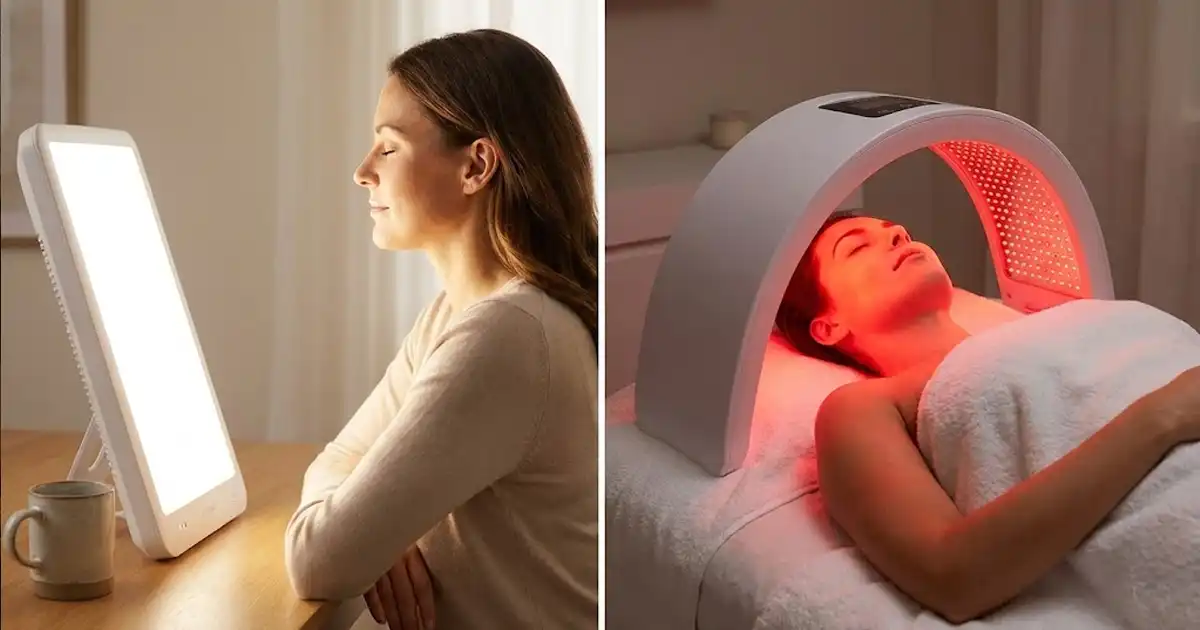
Be aware of a common misconception: traditional light therapy, used to treat seasonal affective disorder, works through the eyes using white light. It has nothing to do with skin photomodulation. We discuss this in detail in our article “Light Therapy or Photobiomodulation.”
How Does Light Affect the Skin?
Red light (approximately 630–660 nm) and near-infrared light (approximately 810–850 nm) pass through the outer layers of the skin. It is absorbed by an enzyme in the mitochondria called cytochrome c oxidase. The cell then produces a small amount of additional energy in the form ofATP.
Red light acts mainly on the surface. Near-infrared light penetrates deeper, reaching the muscles and joints. That’s why high-quality devices often combine both wavelengths. For more details, see our guide to red light and near-infrared light.
Facial Photomodulation: What the Studies Show
This is the most well-known use. A controlled trial involving 136 volunteers tested two sources of red light, twice a week for 30 sessions. The treated participants showed improvements in skin tone, skin roughness, and collagen density compared to the control group (Wunsch and Matuschka, 2014).
A Harvard University review also describes its effects on wrinkles, acne scars, and wound healing, with almost no adverse effects (Avci et al., 2013).
Let's be honest: the results are gradual. It takes several weeks of regular sessions before you'll see a difference. A single session at a spa mainly gives you a temporary "healthy glow." To learn more, read our feature on LED face masks and their benefits for the skin.
Other Applications of LED Photomodulation
Research is not limited to the face. The best-documented uses are:
- muscle recovery and athletic performance;
- certain joint and tendon pains;
- the prevention of oral mucositis in patients undergoing cancer treatment in a hospital setting;
- hair regrowth, using special helmets or caps.
Each application requires a specific dose and duration. Our page on the benefits of photobiomodulation provides a breakdown by application.
Is photomodulation dangerous?
The safety profile is good. There is no UV radiation, no risk of burns with a properly designed LED device, and side effects are rare: temporary redness and a sensation of warmth. However, there are two points worth noting.
First, protect your eyes. Never stare directly at a powerful LED light source. The glasses provided with the device are not just a gimmick. Second, certain situations require medical advice: pregnancy, active cancer, photosensitive epilepsy, or taking photosensitizing medications. The complete list can be found in our article , “Is Photobiomodulation Dangerous?”
Photomodulation at a beauty salon or at home?
At a beauty salon, a session usually costs a few dozen euros. The equipment is often more powerful, but you need to repeat the sessions to see results. At home, an LED mask or panel pays for itself quickly if you use it regularly.
The key factor isn't the price, but the actual power (irradiance) and the advertised wavelengths. Be wary of 30-euro masks that don't come with a technical specification sheet. Our guide on how to choose a photobiomodulation device provides you with the information you need, and our photobiomodulation pricing page compares prices. You can also check out our selection of photobiomodulation devices.
Frequently Asked Questions
How many photomodulation sessions are needed?
For the skin, the treatment regimens we’ve studied typically involve 2 to 3 sessions per week for 8 to 12 weeks. See our article on treatment frequency.
Does photomodulation help you tan?
No. The light used does not contain UV rays and does not promote tanning.
Can you do photomodulation every day?
More isn't always better. Beyond a certain dose, the effect diminishes: this is known as the biphasic curve. Follow the dosing intervals specified by the manufacturer.
Our guides