cellular-mechanisms-of-photobiomodulation

A Simple Guide to Understanding How Light Affects Our Cells
Photobiomodulation (PBM) is a gentle technology that uses red and/or near-infrared light to help our cells function more effectively. It is non-invasive, painless, and naturally stimulates internal biological responses.
How light affects cellular energy
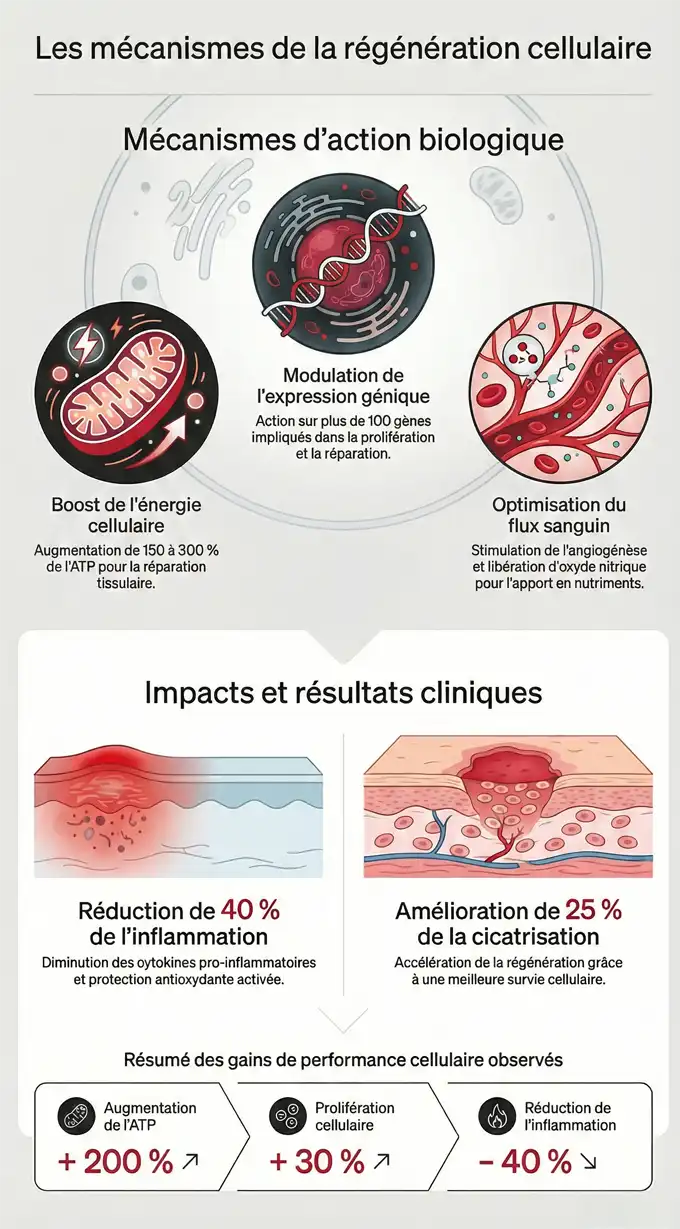
Light reaches the mitochondria—the "powerhouses of the cell"—which can be compared to power plants. These structures produceATP, a molecule essential for cellular activity. When exposed to the right amount of light, mitochondria produce more energy. As a result, cells repair themselves faster, function better, and support tissue regeneration.
A natural anti-inflammatory effect thanks to NO
Light also triggers the release of nitric oxide (NO). This gas plays a major role: it dilates blood vessels, improves microcirculation, and reducesinflammation. This mechanism promotes faster recovery and significant pain-relieving effects.
A mild reaction to stimulate regeneration
Photobiomodulation induces a mild, controlled form of oxidative stress by stimulating the production of ROS (reactive oxygen species). Unlike a toxic excess, this stress is beneficial: it triggers defense and repair signals within the cells. This helps to naturally activate the body’s healing pathways.
The right balance for optimal results
The intensity and duration of exposure are key factors. A low dose of light is stimulating, but too high a dose can block the effect. This is known as the biphasic curve. This principle explains why each treatment protocol is finely tuned to the specific application (anti-aging, pain relief, recovery, inflammation, etc.).
Photobiomodulation: A Detailed Look at Cellular Mechanisms
PBM works by absorbing photons in specialized intracellular structures called chromophores, primarily in the mitochondria. This triggers a cascade of regulated biochemical reactions.
Role of cytochrome c oxidase and the respiratory chain
Cytochrome c oxidase (CCO), a key enzyme in mitochondrial complex IV, is the primary target for photons (600–900 nm). Its activation enables:
- the release of NO, which inhibited the enzyme;
- the resumption of electron transport in the respiratory chain;
- an increase in mitochondrial membrane potential;
- increased production ofATP by ATP synthase.
This mechanism re-energizes cells, supporting their vital functions and regeneration.

⚡ PHOTOBIOMODULATION
Mitochondrial respiratory chain
Step
Description
The respiratory chain is a series of protein complexes located within the inner membrane of the mitochondria that are responsible for producing ATP from NADH and FADH₂ generated during the body’s various catabolic pathways.
This energy production is made possible by the formation of an electrochemical proton gradient in the intermembrane space, which is itself driven by the energy of electrons derived from NADH and FADH₂. The high-energy electrons recovered are then transported sequentially through the various complexes:
- Complex I has an effect NADH coenzyme Q reductase, recovering electrons from NADH and facilitating the transport of 4 protons from the mitochondrial matrix to the intermembrane space.
- Complex II has an effect succinate coenzyme Q reductase, recovering electrons from FADH₂ and allowing the transport of no protons.
- Complex III has an effect coenzyme Q cytochrome C reductase, and facilitates the transport of 4 protons from the mitochondrial matrix to the intermembrane space.
- Complex IV has an effect cytochrome C oxidaseand facilitates the transport of 2 protons from the mitochondrial matrix to the intermembrane space.
- Coenzyme Q (or ubiquinone) facilitates the transition between Complex I or II and Complex III.
- Cytochrome C facilitates the transition between Complex III and Complex IV.
Following the protein complex chain, the final electron acceptor is oxygen, which will thus lead to the formation of water molecules. NADH will therefore enable the transport of 10 protons from the mitochondrial matrix to the intermembrane space, while FADH₂, of only 6. These will return to the mitochondrial matrix via a proton pump also known asATP synthase, which is responsible for ATP production.
Nitric oxide release and intracellular signaling
Released NO does not act solely at the local level. It initiates cellular signaling pathways, modulating the activity of genes involved in:
- vasodilation (improved blood flow);
- reducing inflammation;
- neuromodulation (pain management).
Reactive oxygen species: controlled oxidative stress
Mitochondrial activation leads to moderate production of ROS, which serve as intracellular second messengers. This activates the following pathways:
- Nrf2 (cellular detoxification),
- NF-κB (immune response),
- MAPK/ERK, Akt/PI3K, and CREB (repair, proliferation, anti-apoptosis).
This controlled oxidative stress does not harm the cell, but rather prepares it to defend itself and heal more quickly.

LED Photobiomodulation and Key Parameters
Cellular effects depend heavily on specific physical parameters:
- type of emitter (LED or laser),
- wavelength,
- light output,
- energy density (fluence in J/cm²),
- exposure time,
- frequency of sessions.
Improper adjustment can limit or even reverse the expected beneficial effects.
Side Effects and Cell Safety
When administered at the correct dosage, PBM has no known side effects. However, poorly controlled oxidative stress or excessive light energy could lead to cellular inhibition. It is therefore essential to follow validated clinical protocols.
The biphasic curve: biochemical basis
The biphasic dose-response curve, derived from theArndt-Schulz law, describes the following paradoxical effect:
- A low fluence (0.5 to 5 J/cm²) stimulates cellular activity;
- A dose that is too high (>10 J/cm²) inhibits the response or even causes oxidative stress.
This is why it is important to adhere to the therapeutic parameters: fluence, wavelength, duration, and frequency. Each tissue type and each indication requires a personalized approach.

Therapeutic Applications of Cellular Mechanisms
The cellular mechanisms described explain the therapeutic effects observed in photobiomodulation: reduced inflammation, pain relief, enhanced wound healing, improved muscle performance, and support for cognitive function. A detailed understanding of these mechanisms makes it possible to optimize personalized treatment protocols for each patient.
Frequently Asked Questions
What cellular mechanisms are stimulated by photobiomodulation?
Red and infrared light primarily activate the mitochondria. This leads to increasedATP production (cellular energy), the release of nitric oxide (NO), modulation of oxidative stress, and improved intracellular signaling.
What is the role of cytochrome c oxidase?
Cytochrome c oxidase is a light-sensitive receptor located in the mitochondrial membrane. It absorbs light in the red and near-infrared wavelengths, triggering a series of metabolic reactions, including ATP synthesis and the activation of cellular repair processes.
How does light affect inflammation?
Photobiomodulation reduces the activity of pro-inflammatory cytokines and stimulates tissue repair. It helps manage chronic inflammation by rebalancing cellular responses without the side effects associated with medication.
Scientific sources cited
- by Freitas L.F., Hamblin M.R. (2016). Proposed mechanisms of photobiomodulation or low-level light therapy.
Link to the study
→ Describes in detail the cellular mechanisms involved: mitochondria, ATP, NO, calcium, and inflammatory modulation. - Karu T.I. (2010). Multiple roles of cytochrome c oxidase in low-level light therapy.
Link to the study
→ Highlights the central role of cytochrome c oxidase as an intracellular photoacceptor for red and IR wavelengths. - Hamblin, M.R. (2017). Mechanisms and doses for photobiomodulation therapy.
Link to the study
→ Provides an overview of the biochemical pathways involved in the response to light and the dose-response relationship. - Mitrofanis, J. (2013). Why and how does photobiomodulation change brain activity?
Link to the study
→ Explores the neurological effects of light on neuronal cells: neuroprotection, synaptic activation.
See also
Our guides