LED Photobiomodulation: Cellular Benefits and Side Effects

LED photobiomodulation is an innovative, non-invasive technology that uses LED light to stimulate cellular activity. It is designed to enhance tissue regeneration and alleviate certain side effects of medical or cancer treatments.
This article provides a detailed explanation of what photobiomodulation is, how it works at the cellular level, its many benefits, and its various applications, particularly in oncology and dermatology.
Find out why this therapy is gaining popularity among patients and healthcare professionals, and what precautions to take to ensure its safe and effective use.
By reading this article, you will learn what photobiomodulation is, how it affects cells, its effects on ATP production, its uses (such as treating acne, promoting wound healing, reducing inflammation, and stimulating hair regrowth), its role in managing the side effects of cancer treatments, and the precautions to take for safe and effective use.
What is photobiomodulation (PBM) and how does it work?
Photobiomodulation (PBM) is a non-invasive method that involves the application of red or near-infrared light to stimulate the body's cells.
This technique is also known as low-intensity phototherapy or light therapy. It involves exposing tissues to specific wavelengths in the visible and near-infrared spectrum.
These non-ionizing light sources can activate certain biological functions without heating or damaging the skin, thanks to non-thermal doses.
This light therapy is now used to treat a wide range of conditions, from acne to wound healing, as well as to manage certain side effects of cancer treatments.
It is a painless treatment with no major side effects in the vast majority of cases.

How does LED photomodulation work at the cellular level?
The principle of photobiomodulation is similar to photosynthesis in plants: light energy is absorbed by cells, particularly by the mitochondria. Depending on their wavelength, photons from LED or laser light activate a key enzyme called cytochrome c oxidase.
This activation stimulates the production of ATP (adenosine triphosphate), the molecule that provides the energy necessary for proper cellular function. The absorption of photons by the mitochondria promotes proper cellular function.
Increased ATP levels promote cell regeneration, tissue repair, collagen and elastin production, and reduced inflammation. This process optimizes cellular metabolism and enhances the vitality of the treated tissues.
Photobiomodulation uses LEDs to emit cold light, unlike a laser. Photobiomodulation devices emit red or near-infrared LED light at a specific wavelength.
What is the difference between LED photobiomodulation and laser photobiomodulation?
Photobiomodulation can be performed using LEDs (light-emitting diodes) or low-level lasers (Low Level Laser Therapy, LLLT). Both light sources emit specific wavelengths, but there are some key differences between them.
In terms of light type, LEDs emit incoherent, diffuse light. Lasers, on the other hand, produce coherent, directional light.
As for penetration depth, that of LEDs varies depending on the wavelength, while that of lasers is often greater. In terms of safety, LEDs are very safe, with little risk of burns. Lasers, on the other hand, require precautions.
Finally, the applications differ. LEDs are used for a wide range of applications, such as treating acne, promoting wound healing, and anti-aging. Lasers are often used for medical or dental applications, or for those requiring more targeted wound healing.
LEDs are preferred for their safety, ease of use, and ability to treat large areas, while lasers are used for more targeted applications that require deeper penetration.
What are the benefits of photobiomodulation?
The benefits of LED photobiomodulation are numerous and scientifically proven. Among them is the stimulation of collagen and elastin production, where red and near-infrared light stimulates the production of these proteins, improving the skin’s firmness and elasticity.
It also has anti-inflammatory properties, which are helpful for treating acne, muscle or joint pain, and soothing skin inflammation such as radiation dermatitis.
It helps speed up the healing process, promoting tissue repair following injuries, surgeries, or burns.
It also has analgesic properties, helping to relieve pain associated with various conditions, including cancer-related pain.
Finally, it improves quality of life by reducing certain side effects of medical treatments, particularly in oncology. The therapy helps regenerate tissue and combat oxidative stress by stimulating ATP production, thereby promoting effective regeneration.
Photobiomodulation and inflammation: what is the connection?
Photobiomodulation is particularly effective at reducing skin inflammation, such as radiation dermatitis or inflammation associated with other conditions. By stimulating cellular signaling pathways, this therapy modulates the inflammatory response. Red and near-infrared light are key to reducing inflammation and promoting the regeneration of damaged tissue.
Reducing inflammation is a major benefit. It is helpful for acne, muscle or joint pain, and for soothing skin inflammation such as radiation dermatitis.
What are the possible side effects of photobiomodulation?
Photobiomodulation is a non-invasive and painless therapy that generally has no major side effects. However, some adverse reactions may occur. These mainly include temporary redness or skin irritation, especially in those with sensitive skin. In rare cases, certain skin conditions may temporarily worsen.
There are contraindications for people taking photosensitizing medications or suffering from certain skin conditions.
It is essential to protect your eyes and follow safety protocols to avoid even the slightest risk.
No serious long-term side effects have been reported with the proper use of photobiomodulation devices.
What happens during a photobiomodulation session?
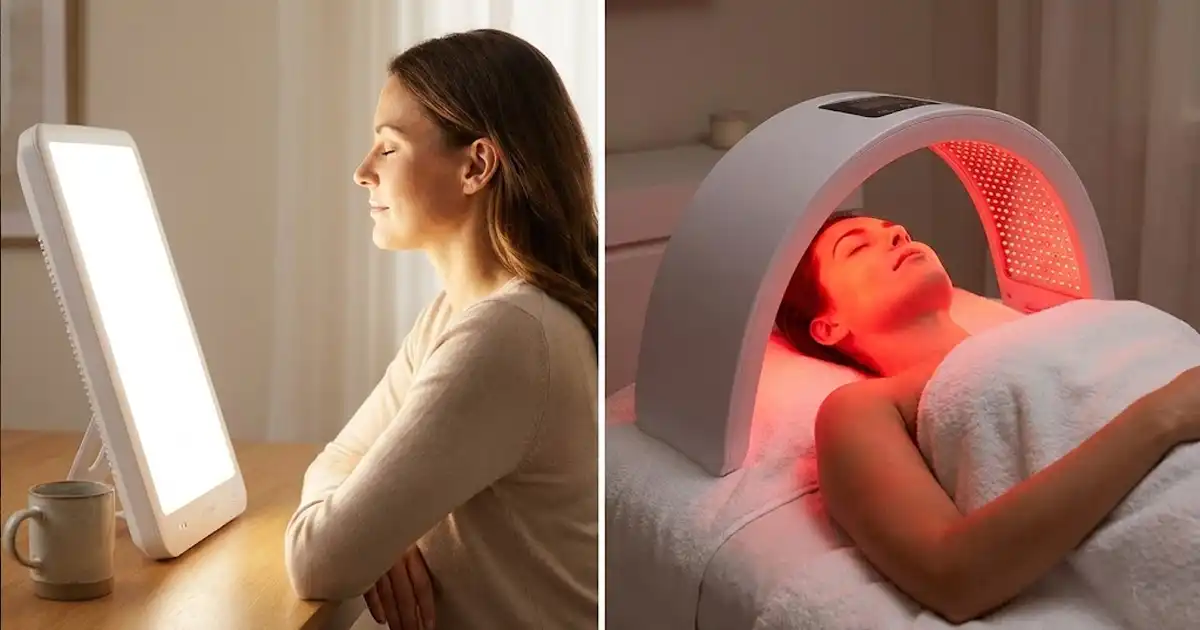
A photobiomodulation session uses light; it begins with the application of LED light to the treatment area, at a distance and for a duration determined by the protocol. The light panels or LED lamp are positioned to emit light at the correct wavelength (generally between 630 and 850 nm for red and infrared light).
A photobiomodulation session typically lasts between 15 and 30 minutes, depending on the treatment area and the specific condition being treated. Multiple sessions are often necessary to achieve optimal results, depending on the treatment plan established by the healthcare professional.
What are the medical indications for photobiomodulation?
Photobiomodulation is indicated in many medical and cosmetic fields. For the treatment of acne, blue light has antibacterial and anti-inflammatory effects, while red light promotes healing. It is also used for skin regeneration and anti-aging by stimulating collagen and elastin production, reducing wrinkles, and improving skin texture.
It promotes the healing of wounds and burns, accelerating tissue repair following surgery, radiation therapy, or injury. It is also used to manage the side effects of cancer treatments, including the prevention of mucositis, the reduction of neuropathy, and the mitigation of chemotherapy-related hair loss.
Photobiomodulation as an adjunct to cancer treatments: what are the benefits?
It is beneficial for cancer patients, particularly in mitigating certain side effects of treatment. It is indicated for the prevention and treatment of mucositis (inflammation of the mucous membranes) in cancer patients undergoing radiation therapy or chemotherapy. It helps reduce dermatitis (skin inflammation) and promotes healing of irradiated tissues.
It improves quality of life by reducing pain, inflammation, and fatigue associated with intensive treatments. At Gustave Roussy, protocols are in place to treat neuropathies and support tissue regeneration. Cancer-related pain can be alleviated, and it is possible to prevent chemotherapy-induced mucositis.
Protocols and precautions for photobiomodulation?
To ensure the effectiveness and safety of photobiomodulation, it is important to optimize results by following certain guidelines. Certified photobiomodulation devices should be used, appropriate for the specific indication and the area to be treated. It is essential to follow the protocols established by professionals, including the selection of wavelength, exposure duration, and number of sessions.
It is crucial to protect the eyes during light application. The treatment must also be adjusted in the event of a skin reaction or adverse effect. Finally, photobiomodulation should be avoided in cases of medical contraindications (photosensitive conditions, certain medications, etc.).
A tailored treatment plan and the selection of high-quality equipment ensure effective results. A personalized treatment plan and adherence to medical guidelines are essential for optimizing results and ensuring treatment safety.
Key takeaways
Here are the most important points to remember about photobiomodulation:
- Photobiomodulation is a non-invasive method that uses LED or laser light to stimulate cellular activity and optimize cellular metabolism. It involves exposure to cool, non-invasive light.
- It primarily acts on the mitochondria, increasing ATP production and promoting cell regeneration, wound healing, and collagen production.
- The benefits of photobiomodulation include reducing inflammation, managing certain side effects of cancer treatments, improving quality of life, and stimulating hair regrowth.
- Side effects are rare and generally mild (redness, irritation), provided that protocols and precautions are followed. Some side effects are very rare and minor.
- Photobiomodulation is recommended for a wide range of conditions, including acne, wound healing, anti-aging, pain, inflammation, neuropathies, and more. It is effective for hair regrowth, as well as inflammation and pain associated with cancer.
- A personalized treatment plan and adherence to medical guidelines are essential for optimizing results and ensuring treatment safety. A tailored treatment plan and the selection of high-quality equipment ensure effective results.
- Photobiomodulation can be a valuable complement to other therapies.
- There are photobiomodulation devices available for home use. The choice of a device depends on several factors: the wavelengths used (ideally between 630 nm and 850 nm to cover the visible and near-infrared spectrum), the power output, and the build quality.
LED photobiomodulation represents a major advance in skin care, pain management, and patients’ quality of life, particularly in the context of cancer treatment. Its future looks promising thanks to ongoing research and improvements in devices and protocols.
Frequently Asked Questions
What is photobiomodulation?
This is a non-invasive therapy that uses low-intensity LEDs or lasers. It stimulates cells using red or infrared light, improving tissue regeneration, circulation, pain relief, and overall well-being.
What are its main applications?
PBM is used in dermatology (acne, wrinkles) to relieve muscle and joint pain, improve physical recovery, sleep, mood, and even certain cognitive functions.
Is this a scientifically validated technique?
Yes. Hundreds of studies have confirmed the biological effects of low-intensity light, particularly on mitochondria, ATP production, and the regulation of inflammation.
Scientific sources cited
- Chung H. et al. (2012). The Nuts and Bolts of Low-level Laser (Light) Therapy.
→ Provides an overview of the scientific basis, cellular mechanisms, and therapeutic indications of photobiomodulation. - by Freitas L.F., Hamblin M.R. (2016). Proposed mechanisms of photobiomodulation or low-level light therapy.
Link to the study
→ Details the main intracellular targets of light, particularly mitochondria and anti-inflammatory systems. - Anders J.J. et al. (2015). Low-level light/laser therapy versus photobiomodulation therapy: The semantic shift of a medical modality.
Link to the study
→ Clarifies the definitions and the transition from the term LLLT to PBM, which is more precise and has a stronger scientific foundation. - Wang Y. et al. (2021). Photobiomodulation therapy: Applications and mechanisms.
Link to the study
→ Provides an updated summary of the validated uses of PBM: skin, pain, the nervous system, physical performance, and sleep.
See also
Our guides