The Role of ATP in Photobiomodulation
A Simple Guide to Understanding How Light Boosts Cellular Energy
Photobiomodulation, or PBM, uses red or infrared light to directly affect cells. One of the main effects of this technology isto increase the productionof ATP, the molecule that provides energy to our cells.
What is ATP?
ATP (adenosine triphosphate) is a molecule produced by our cells, specifically in the mitochondria. It is considered the body’s “energy currency.” Without ATP, our cells cannot repair themselves or function properly.

How light increases ATP production
When light penetrates the skin, it stimulates the mitochondria. The mitochondria use this light energy to accelerate ATP production. It’s as if they were getting a natural boost. This helps cells regenerate more effectively, heal faster, and better defend themselves against environmental stressors.
Why it's important for the body
A healthy ATP level means more energy for the skin, muscles, brain, and even the immune system. It’s the key to restoring vitality, relieving certain types of pain, or recovering after physical exertion.
ATP: A Scientific and Biochemical Explanation
Photobiomodulation leads to an increase in intracellular ATP by activating the mitochondrial respiratory chain, specifically through cytochrome c oxidase (Complex IV).
Electron transport chain and ATP synthesis
Light stimulation (600–900 nm) increases the activity of cytochrome c oxidase. This reactivates electron transport, boosts the proton gradient in the intermembrane space, and enables accelerated ATP production byATP synthase. This has a direct effect on cellular bioenergetics.
The central role of ATP in cellular processes
ATP is essential for:
- cell proliferation,
- protein synthesis,
- muscle contraction,
- active transport of nutrients,
- intracellular signaling.
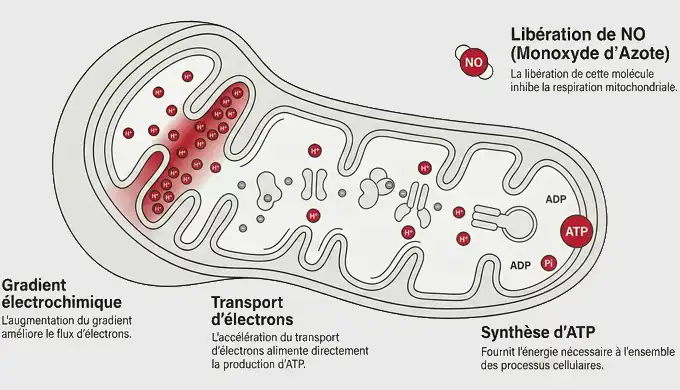
An increase in intracellular ATP accounts for the effects observed in PBM: tissue repair, reduced inflammation, and improved physiological performance.
Mitochondria, stress, and photostimulation
In addition to producing ATP, PBM protects mitochondria from oxidative stress and makes them more efficient. It reduces the binding of NO to Complex IV, which boosts enzymatic activity and improves energy yield.
Frequently Asked Questions About ATP
What is the connection between light and ATP?
Red and infrared light stimulate an enzyme called cytochrome c oxidase in the mitochondria. This accelerates the cellular respiratory chain and increases the production of ATP, the cells’ primary source of energy.
Why is ATP so important for cells?
ATP (adenosine triphosphate) is the universal energy molecule. It enables cells to regenerate, divide, heal, and respond to external stressors. Without ATP, no vital processes can be sustained.
What happens if ATP production is too high?
A sudden surge in ATP is rare, as cells naturally regulate their production. However, overexposure to light could lead to secondary oxidative stress. This is why it is important to use a carefully calibrated dose.
Scientific sources cited
- Karu T.I. (2010). Multiple roles of cytochrome c oxidase in low-level light therapy.
Link to the study
→ Describes how red light stimulates cytochrome c oxidase, leading to a direct increase in ATP production. - Chung H. et al. (2012). The Nuts and Bolts of Low-level Laser (Light) Therapy.
Link to the study
→ Confirms that the increase in intracellular ATP is a central mechanism of photobiomodulation, promoting repair and regeneration. - Passarella S., Karu T. (2014). Absorption of monochromatic and narrow-band radiation in the visible and near-infrared by cytochrome c oxidase.
Link to the study
→ Highlights the direct link between light absorption by mitochondria and increased ATP production. - Pastore D. et al. (1999). In vivo increase of mitochondrial activity in rat liver by light irradiation.
Link to the study
→ In vivo study confirming that red light stimulates mitochondrial activity and ATP production in liver tissue.
See also
Our guides