Photobiomodulation in Gynecology: Uses and Safety

Photobiomodulation (PBM) uses low-power red and near-infrared wavelengths to stimulate cellular activity without heating or damaging tissues. When applied in the field of gynecology—to the vulvar and vaginal mucosa as well as the pelvic floor—it is attracting growing interest as a nonhormonal and noninvasive option. This article provides an overview of its studied applications, mechanisms of action, the current level of evidence, and essential precautions.
What is photobiomodulation in gynecology?
Gynecological PBM involves exposing genital tissues to low, non-thermal doses of light, typically in the red (around 630–660 nm) and near-infrared (around 810–850 nm) spectra. The treatment can be applied topically to the vulvar region or intravaginally using probes designed for this purpose. Unlike surgical procedures, the goal is not to damage the tissue to stimulate regeneration but to trigger a gentle biological response at the cellular level.
How does it affect gynecological tissues?
The principle is the same as elsewhere in the body. Light is absorbed by the mitochondria, which stimulates ATP production and a cascade of responses that promote cellular repair. In the genital mucosa, the desired effects include improved microcirculation, support for collagen synthesis and tissue hydration, as well as an anti-inflammatory effect. These mechanisms are well understood biologically; their clinical implications in gynecology are still being evaluated.
In what contexts is it studied?
Genitourinary Syndrome of Menopause
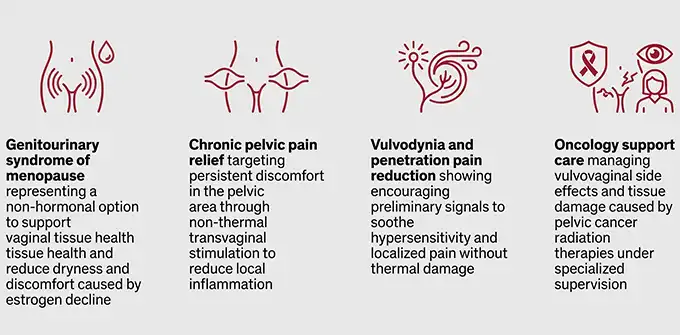
This is the most well-documented indication. The drop in estrogen levels after menopause leads to dryness, vulvovaginal discomfort, and sometimes pain during intercourse. PBM is being studied as a nonhormonal alternative to support mucosal trophicity. Several studies describe the biological rationale and encouraging preliminary results, and controlled trials are currently underway.
Chronic pelvic pain
A pilot study on transvaginal PBM reported a significant and sustained reduction in pain among women with chronic pelvic pain, an area where treatment options remain limited. These results, derived from a small sample size without a control group, need to be confirmed.
Vulvodynia and pain during penetration
Several studies have examined the use of low-intensity light in the treatment of vulvodynia. Reviews highlight positive findings but note that there are still not enough robust studies.
Supportive Care in Oncology
Building on the already recognized role of PBM in treating radiotherapy-induced mucositis and radiation dermatitis, its potential is being explored for vulvovaginal complications associated with treatments for pelvic cancers. This use requires specialized oncological supervision.
PBM and vaginal laser therapy: a key distinction
The term “vaginal laser” actually encompasses two very different approaches. Ablative or fractional lasers (CO2, Er:YAG) create controlled thermal micro-lesions to stimulate tissue remodeling. Photobiomodulation, on the other hand, is non-ablative and non-thermal: it modulates cellular activity without damaging the tissue. These are two distinct mechanisms, each with its own safety profile and data. Confusing the two leads to unrealistic expectations.
What does the research actually say?
Honestly, the evidence still needs to be strengthened. Most of the available studies are small in scale, often lack a control group, and recent reviews call for larger randomized trials before any firm recommendations can be made. Some reviews even conclude that the current data are insufficient to support the use of PBM for certain indications, such as chronic pelvic pain. Gynecological PBM should therefore be presented as a promising approach currently under evaluation, not as an established treatment.
Safety and Contraindications
PBM is a non-thermal, non-invasive procedure that is generally well tolerated. However, caution is advised—or prior medical consultation is required—in certain situations: pregnancy; active cancer in the treatment area outside of a supervised protocol; and any undiagnosed bleeding or lesion, which must first be evaluated. For more details, see our article on the contraindications of photobiomodulation.
Essential medical care
In gynecology more than in any other field, PBM should not be attempted as a form of self-treatment. The decision regarding the indication, parameters, and follow-up must be made by a healthcare professional as part of a comprehensive and personalized care plan. A preliminary examination helps rule out any underlying causes that would require a different treatment.
Frequently Asked Questions
Is gynecological photobiomodulation painful?
No. It is painless and does not involve heat: most women feel only a slight warmth, or nothing at all.
Has this been scientifically proven?
The preliminary results are encouraging, but the evidence has not yet been established through large-scale controlled trials. This approach is currently being evaluated and should be considered as a complementary option.
Is this the same thing as vaginal laser treatment?
No. PBM is non-ablative and non-thermal, unlike ablative vaginal lasers (CO2, Er:YAG), which rely on thermal action.
Scientific sources
According to PubMed:
- Lanzafame RJ, de la Torre S, Leibaschoff GH (2019). The Rationale for Photobiomodulation Therapy of Vaginal Tissue for the Treatment of Genitourinary Syndrome of Menopause. Photobiomodul Photomed Laser Surg. DOI
- Zipper R, Pryor B, Lamvu G (2021). Transvaginal Photobiomodulation for the Treatment of Chronic Pelvic Pain: A Pilot Study. Women’s Health Report. DOI
- Starzec-Proserpio M, Bardin MG, Morin M (2023). Not all lasers are the same: a scoping review evaluating laser therapy for vulvodynia. Sex Med Rev. DOI
- Iglesia CB, Choi JE, Tadir Y (2024). Lasers in Gynecology. Obstet Gynecol. DOI
- Pereira SRDS et al. (2024). Photobiomodulation in postmenopausal genitourinary syndrome: study protocol for a randomized controlled trial. PLoS One. DOI
- Laubach HJ, Robijns J (2018). Laser and light therapy for the treatment of radiation dermatitis. Hautarzt. DOI
See also
Our guides