Photobiomodulation: In what cases is it contraindicated?

Photobiomodulation is a gentle, non-invasive technology that is well tolerated by most users. However, like any treatment, it is not recommended in certain situations. It is important to follow these recommendations to ensure safe use.
Is photobiomodulation dangerous?
No. It is neither thermal, ionizing, nor invasive. It uses natural wavelengths to stimulate cellular biology. Thousands of studies and clinical applications confirm that it is well tolerated. But that does not mean it is suitable for every situation.
👉 For more general information, visit our page “Photobiomodulation: is it dangerous?”
What are the main contraindications?
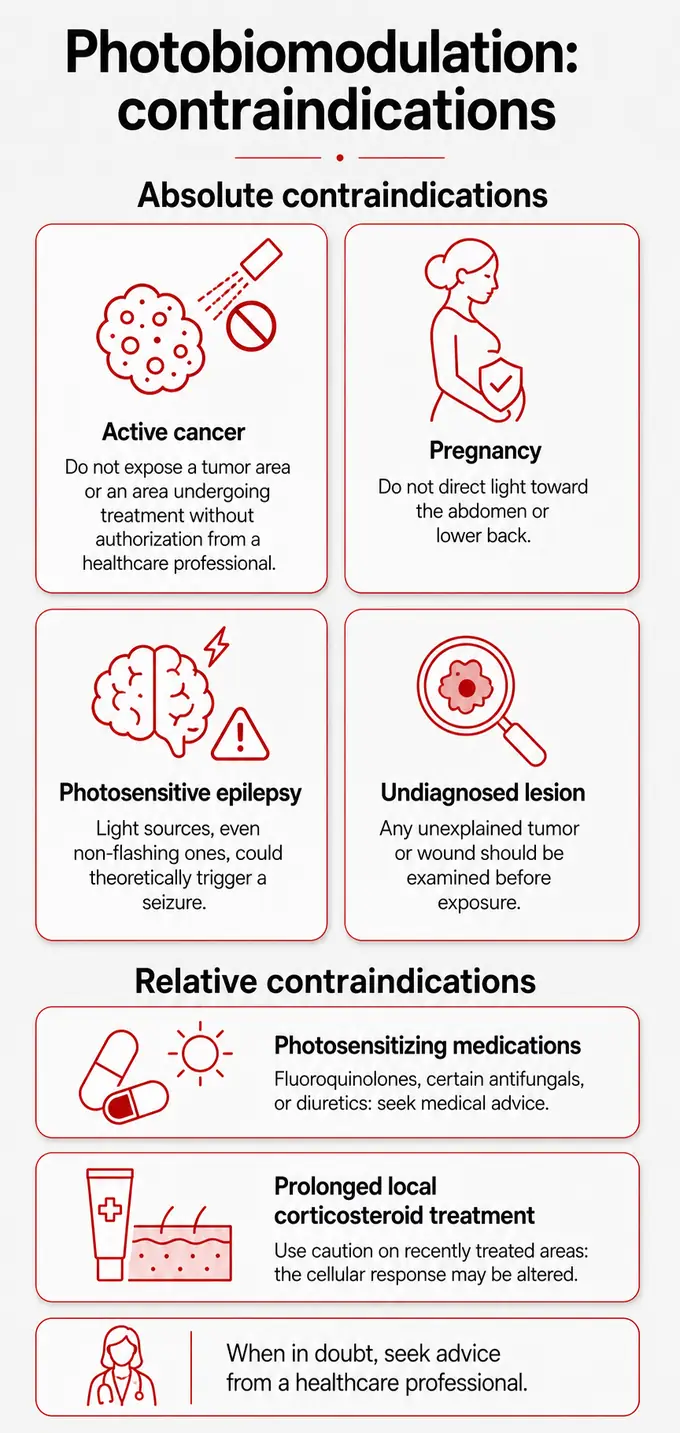
Absolute contraindications
- Active cancer
(tumor present or currently undergoing treatment): unless authorized by a healthcare professional. - Pregnancy
As a precaution, the light should not be directed at a pregnant woman’s abdomen or lower back. - Photosensitive epilepsy
Exposure to light sources, even non-flickering ones, can theoretically trigger a seizure. - Undiagnosed lesion
Any unexplained tumor or wound must be examined before considering light exposure.
Relative contraindications
- Taking photosensitizing medications
(e.g., antibiotics in the fluoroquinolone class, certain antifungal medications, or diuretics). Consult a healthcare professional. - Prolonged topical corticosteroid treatment
May interfere with the cellular response to light. Use with caution on recently treated areas.
Photobiomodulation and Children
Its use may be considered in certain contexts (e.g., neurodevelopmental disorders, wound healing), but always under professional supervision.
Photobiomodulation and Medical History
It is recommended that you consult a healthcare professional if you have:
- A history of cancer
- A progressive autoimmune disease
- Immunosuppressive therapy
- Hormonal or thyroid disorders
Light acts at the cellular level: adjusting the protocol may be helpful.
PBM Devices: How to Choose and Use Them Properly
For safe use at home:
- Follow the recommended exposure protocols
- Use certified devices such as the PBM-300 or the PBM-600
- Avoid direct contact with the eyes (wear safety goggles if necessary)
Frequently Asked Questions
Is photobiomodulation safe for everyone?
It is generally well tolerated, but certain situations require extra caution.
In what situations is PBM not recommended?
Active cancer, pregnancy, photosensitive epilepsy, unexplained skin lesions, photosensitizing treatments, etc.
Are there any side effects?
These are rare: a sensation of warmth, localized redness, and temporary headaches. Staying well-hydrated and taking breaks are recommended.
Scientific sources
- Chung H, Dai T, Sharma SK, et al. (2012). The nuts and bolts of low-level laser (light) therapy. Ann Biomed Eng. PubMed · DOI
- Robijns J, Nair RG, Lodewijckx J, et al. (WALT) (2022). Photobiomodulation therapy in the management of cancer treatment-induced side effects: WALT position paper 2022. Front Oncol. PubMed · DOI
- de Freitas LF, Hamblin MR (2016). Proposed Mechanisms of Photobiomodulation or Low-Level Light Therapy. IEEE Journal of Selected Topics in Quantum Electronics. PubMed · DOI
See also
Our guides


.webp)