Photobiomodulation and Longevity: The Mitochondrial Signal
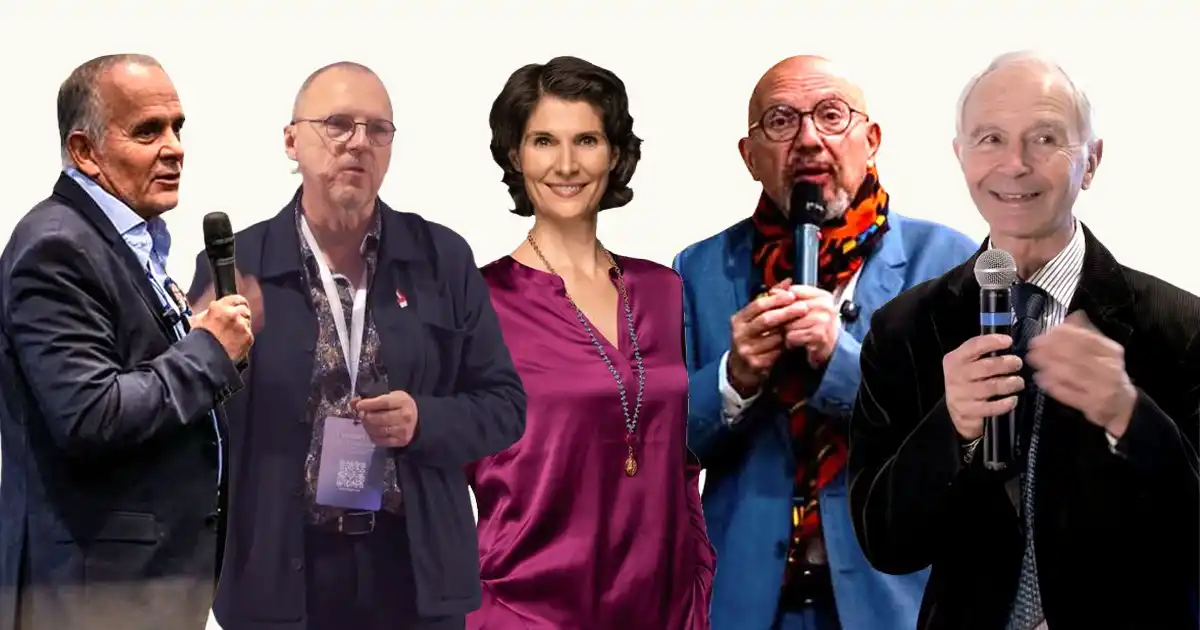
Three conferences, one common theme: mitochondria
Three trade shows in three months. Paris in March, the Gard in May, and Berlin right after that.
I went there for work. I came back with a firsthand understanding of the situation. More and more people don’t just want to live to a ripe old age. They want to live to a ripe old age in good health.
The distinction may seem subtle. Yet it changes everything—even the way we talk about therapeutic light.
And throughout these three events, one word kept coming up. I jotted it down at every lecture. Mitochondria.
Paris, March 21–22: Hypersanté puts the spotlight on the program
First stop: the H4 Wyndham Convention Center in Paris Saint-Denis. Hypersanté bills itself as the first French-language event for the general public dedicated to longevity.
The atmosphere speaks for itself. Over 1,000 attendees. About 50 brands. Dozens of talks and workshops. And a “Longevity Village” where you can have your biological age measured between ice baths.
What made me smile? Seeing photobiomodulation treated as a legitimate topic, not just a curiosity. Dr. Jean-Philippe Wagner devoted an entire lecture to it: “The Red Light Guide.”
Visitors could also test the PBM on site, just like they could measure their metabolism or heart rate. In front of a general audience, this sends a clear message.
Another highlight: the masterclass by Prof. Vincenzo Castronovo (Mitochondrial Academy). Its title, in a nutshell: “Hyperhealth Thanks to Mitochondria.” Remember that name. We’ll be hearing more from him.
Pont du Gard, May: Human Potential Enters the Cell
A complete change of scenery. Here, there’s no massive exhibition hall. Two days of lectures at the foot of the Roman arches, in the scrubland.
This edition was organized in collaboration with the Mitochondrial Academy. It even did away with its workshop program to make way for scientific discussions.
The central theme: the mitochondrion. Previous editions explored the heart, the body, and then the mind. This time, the focus is on this tiny structure, which has long been dismissed as nothing more than a power plant.
The program spoke for itself:
- Leonardo Pelagotti: Heat, Cold, and Breathing to Regenerate Mitochondria.
- Philippe Bobola: “From Mitochondria to Microtubules.”
- Dr. Pierre Maldiney: Care in Mitochondrial Medicine.
Maldiney, Castronovo… the same voices as in Paris. Two conferences that are polar opposites in form. And the same small circle of experts promoting the same idea.
That's when I started taking it seriously.
Berlin, May 29–30: Longevity Takes on a New Dimension
Last stop: the Estrel Berlin, for the second edition of the Life Summit. The contrast with the Gard is striking.
The event has more than tripled in size over the past year. Approximately 3,000 attendees. 150 speakers. Three concurrent sessions. An important detail: the conference was accredited for continuing medical education, offering 12 credits.
Among those in attendance were Robert Lustig, Eric Verdin (Buck Institute), and Bryan Johnson, the founder of the Blueprint Protocol.
And here again, red light therapy had its place. On the list of treatments to try: hyperbaric oxygen therapy, dry floating, IHHT, and red light therapy.
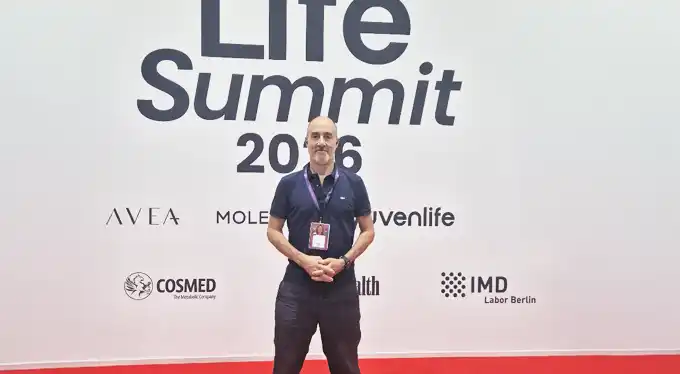
What struck me wasn't the formality. It was that a serious clinical setting coexisted with a space for self-experimentation. And no one found that odd. Five years ago, those two worlds didn't even speak to each other.
It's not just a showroom impression
When I got home, I wanted to check something. Did my notes correspond to anything measurable? The answer: yes.

In 2016, researcher Martin Picard demonstrated this. Medical publications on mitochondria have been steadily increasing since the 2000s. Meanwhile, those on the cell nucleus have been declining since the sequencing of the human genome.
A 2024 bibliometric review goes a step further. It identifies more than 169,000 PubMed publications on mitochondria. The buzz at trade shows isn’t just a fad. It follows the science.
Why this issue directly affects us
This is precisely where photobiomodulation comes into play. Red and near-infrared light are absorbed by a key enzyme in the respiratory chain: cytochrome c oxidase.
This absorption works through two mechanisms: cellular energy production (ATP) and the management of oxidative stress.
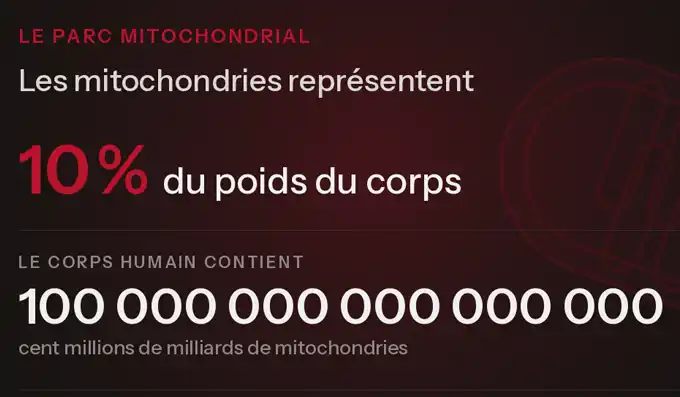
This mechanism has been studied for decades and is constantly being refined. But the point of focus remains the same: the mitochondrion.
That’s why I felt that way as I left Berlin. It wasn’t photobiomodulation that sought out longevity. It was longevity that found its way to where the light was already at work.
For the healthcare professionals reading this, the mitochondrial framework is worth a closer look. It finally provides PBM with a common language—one used at medical conferences and in the field of health optimization.
Three cities. Three audiences. Three atmospheres that have almost nothing in common. And the same word, underlined three times in my notebook.
For more information: Hyperhealth, Human Potential and Life Summit Berlin.
See also
Our News