Hamblin, M.R. - Photobiomodulation and Mitochondrial Redox Signaling: A Review of Mechanisms
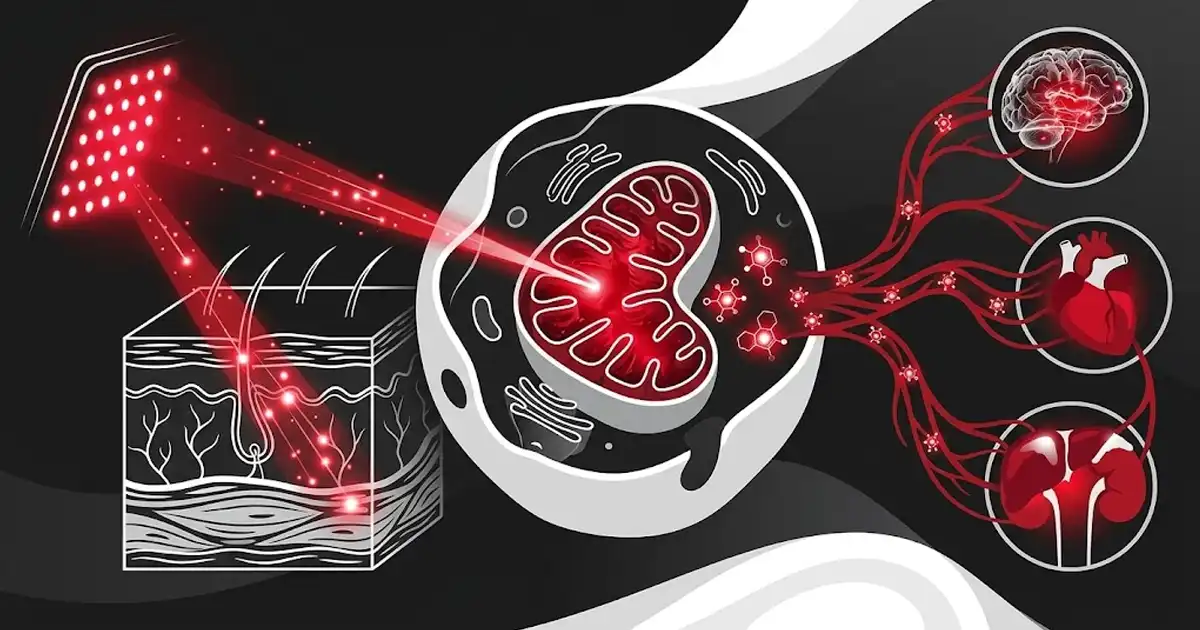
This 2018 review details the mitochondrial pathway of photobiomodulation: red and near-infrared light is believed to be absorbed by cytochrome c oxidase, triggering redox signaling. It presents mechanistic hypotheses but does not measure clinical efficacy.
What This Publication Has Contributed
Michael R. Hamblin, of the Wellman Center for Photomedicine, is the sole author of this review published in *Photochemistry and Photobiology*. His objective is clear: to explain the chain of biochemical events through which low-power-density light can alter a cell’s behavior. The text begins by providing some background. Photobiomodulation uses low-power-density red or near-infrared light and is employed to reduce pain, inflammation, and edema, as well as to regenerate damaged tissues such as wounds, bones, and tendons.
The article’s contribution lies in placing redox signaling at the center of the explanatory model. Rather than describing an overall effect, the author proposes a cascade: light absorption, a change in the cell’s redox state, and then the cell’s response.
Key Points
The abstract of the article identifies several key points.
- The primary site of light absorption in mammalian cells has been identified as the mitochondria, and more specifically, cytochrome c oxidase.
- The proposed hypothesis is that the inhibitory nitric oxide can detach from this enzyme, which would restore electron transport and increase the mitochondrial membrane potential.
- A second mechanism is proposed: the activation of light- or heat-sensitive ion channels.
- The journal distinguishes between healthy cells and cells under stress, in which photobiomodulation can have seemingly opposite effects.
- A marked effect on stem cells has been reported, attributed to this same mitochondrial redox signaling pathway.
- Photobiomodulation can act as a form of preconditioning and interact with exercise at the muscular level.
How Photobiomodulation Works at the Cellular Level
The model described can be summarized in a few steps. A red or near-infrared photon is absorbed by cytochrome c oxidase, the final complex in the mitochondrial respiratory chain. The nitric oxide that was blocking the site dissociates, electron transport resumes, and the mitochondrial membrane potential increases. This change in the redox state then serves as a signal to the rest of the cell.
The most notable point is the distinction between healthy cells and stressed cells. The same light intensity does not produce the same response depending on the cell’s initial state, which helps explain why some experiments yield divergent results. Two caveats are in order: the author himself uses the term “hypothesis” to describe the dissociation of nitric oxide, and the article’s index terms include “animal models,” which serves as a reminder that this mechanism is largely based on studies conducted on cultured cells and in animals.
Limits You Should Know
This is a review of mechanisms, not a clinical trial. The abstract does not include any efficacy data, wavelengths, or doses, and nothing here allows us to infer a protocol. The indications cited are presented as common uses in the field, not as results measured in this study.
Furthermore, the causal chain described remains partially hypothetical. Establishing that cytochrome c oxidase absorbs light is not sufficient to demonstrate that this results in a clinical benefit for a given patient.
Why This Article Is Still Relevant
This is one of the clearest formulations of the mitochondrial model, the one cited in a large number of subsequent publications. The article also introduced two useful concepts: the dependence of the response on the state of the cell, and the idea of preconditioning, in which exposure precedes the stress rather than following it.
Frequently Asked Questions
What is the target of the light in the cell?
The review identifies the mitochondrion as the primary site of absorption in mammalian cells, and within it, cytochrome c oxidase. A second mechanism—the activation of light- or heat-sensitive ion channels—is also discussed.
Why might photobiomodulation have opposite effects depending on the case?
Because the response depends on the cell's condition. The author points out that healthy cells and stressed cells do not react in the same way, which can lead to seemingly contradictory effects.
Does this article demonstrate a health benefit?
No. It describes biological mechanisms and hypotheses. Demonstrating clinical benefit requires controlled trials, which are not part of this study.
Reference
Hamblin, M.R. "Mechanisms and Mitochondrial Redox Signaling in Photobiomodulation." *Photochemistry and Photobiology*, 2018. PMID 29164625. View the study on PubMed
This summary is provided for informational purposes only and does not constitute medical advice. Photobiomodulation is not a substitute for prescribed treatment. Consult a healthcare professional.