Karu T.I. - Red and Near-Infrared Light and Mitochondrial Signaling: A Literature Review
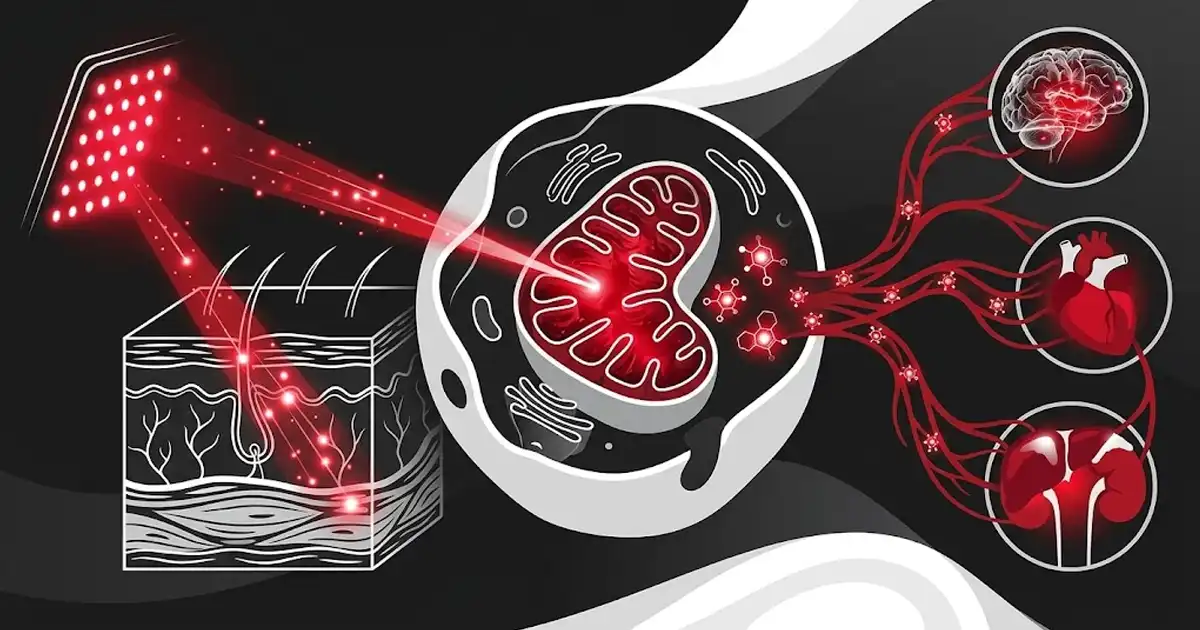
This review examines whether visible or near-infrared radiation can activate the signaling pathway that connects the mitochondria to the cell nucleus. It compiles data obtained in the laboratory using mammalian cells: it is not a clinical trial and does not demonstrate any benefit for patients.
What this publication has shown
Mitochondrial signaling is described here as a channel of information between the mitochondrial respiratory chain and the cell nucleus, transmitting signals about the functional state of the mitochondria. This direction of flow, from the organelle to the nucleus, has a name: retrograde signaling. The nucleus contains the cell’s “instruction manual,” while the mitochondria produce its energy; when the mitochondria change their metabolic state, they inform the nucleus, which then adjusts the activity of its genes.
The question is simple: Can visible or near-infrared radiation—referred to as IR-A—activate this retrograde pathway? To answer this, Tiina Karu, a Russian physicist, has compiled the published experimental data on how irradiation modulates the components of this pathway.
Key Findings
This is a review, not a new experiment: the abstract provides no information on wavelength, dose, or numerical values. It lists the elements of retrograde signaling whose state is altered by irradiation.
- The mitochondrial membrane potential, the difference in electrical charge across the inner mitochondrial membrane.
- Reactive oxygen species, oxygen-derived molecules that act as byproducts and signaling molecules.
- Calcium, a signaling ion that regulates numerous cellular reactions.
- Nitric oxide, a gaseous molecule involved in vascular regulation and cellular respiration.
- Intracellular pH, that is, the acidity inside the cell.
- The balance between fission and fusion of mitochondria, which are constantly dividing and fusing.
Cytochrome c oxidase, the terminal enzyme of the respiratory chain, is considered to be the photoacceptor—that is, the molecule that captures light. The journal attributes two distinct functions to it in irradiated cells: signal generator and signal transducer.
How Light Affects Mitochondria
The process unfolds in three stages. Red or near-infrared light is absorbed by cytochrome c oxidase, the final step in the chain within the mitochondrion that transfers electrons to oxygen to produce energy. This absorption alters the enzyme’s function, and the change affects the parameters listed above, which form the language through which the mitochondria communicate with the nucleus.
The distinction between a generator and a transducer constitutes the conceptual contribution of this review. To generate a signal is to produce the initial message; to transduce it is to convert it from one form to another—in this case, from a photochemical event to a biochemical message. Assigning both roles to the same enzyme makes cytochrome c oxidase the essential link between light and the cellular response.
Limits You Should Know
This publication is a literature review. It does not present any new data, and its validity depends on that of the studies it compiles, which were conducted on cultured cells. It does not include any clinical trials, does not follow any patients, and does not measure any therapeutic benefits.
The abstract does not specify wavelengths, doses, or cell types, which precludes any adaptation to a practical protocol. A pathway described in a culture dish does not necessarily behave the same way in living, perfused tissue. Finally, this text is nearly twenty years old: mitochondrial biology has advanced significantly since then.
Why This Work Is Considered a Classic
This review provided the field with a structured explanatory framework. Before it, the observed effects of red light consisted of a list of scattered findings. By linking them to a pathway already known to biologists, it made these results accessible to researchers from other disciplines.
Frequently Asked Questions
What is retrograde signaling?
Communication flows from the mitochondria to the nucleus, not the other way around. It allows the mitochondria to signal their status so that the nucleus can adjust the activity of its genes.
Does this review demonstrate a therapeutic effect?
No. It describes a mechanism based on laboratory studies. A plausible mechanism is not proof of efficacy, which requires clinical trials.
Why do we say "IR-A" instead of "infrared"?
IR-A refers to the portion of infrared radiation closest to the visible spectrum, which is the only portion relevant to the research discussed in this review.
Reference
Karu TI. Mitochondrial signaling in mammalian cells activated by red and near-infrared radiation. Photochemistry and Photobiology, 2008;84(5):1091-9. PMID 18651871. View the study on PubMed
This summary is provided for informational purposes only and does not constitute medical advice. Photobiomodulation is not a substitute for prescribed treatment. Consult a healthcare professional.