Karu T.I. - Red and Near-Infrared Light and the Roles of Cytochrome c Oxidase: A Literature Review
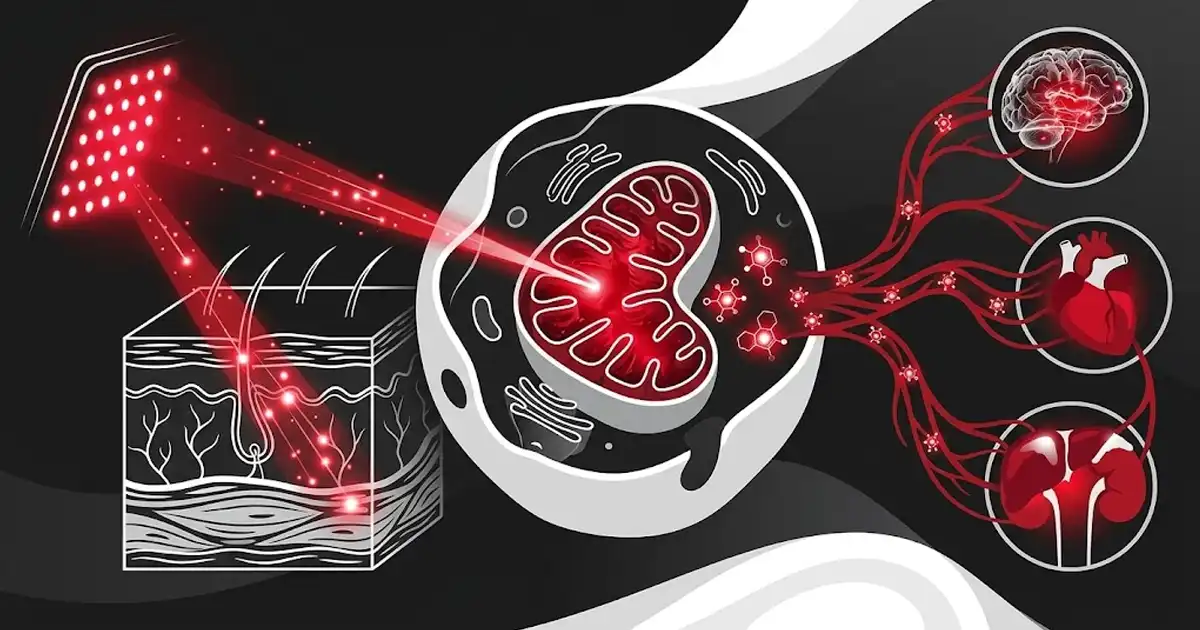
This belated review by Tiina Karu summarizes the effects of red and near-infrared radiation on mammalian cells and human skin. It synthesizes laboratory studies, reports no clinical trials, and demonstrates no benefit for patients.
What this publication has shown
Published in 2010, this review synthesizes the knowledge then available in photobiology and photomedicine regarding the effects of radiation in the red-to-near-infrared region of the solar spectrum, known as IR-A. Three forms are considered: monochromatic, quasi-monochromatic, and broadband. The targets examined are mammalian cells and human skin.
Two ideas form the structure of the text. The first is the role of cytochrome c oxidase, which is described both as a photoacceptor—the molecule that captures light—and as a photosignal transducer—the molecule that converts this light event into a biological signal. Its photosensitivity under certain circumstances is discussed here. The second idea concerns the role of ATP as a critical signaling molecule. This is a notable shift: ATP is usually presented as the cell’s fuel, not as a messenger.
Key Findings
The summary of this review is brief and does not provide any numerical values, specific wavelengths, or doses. What it states falls within the conceptual framework.
- The spectral region under consideration is the red-to-near-infrared (IR-A) portion of the solar spectrum.
- Three types of radiation are covered: monochromatic, quasi-monochromatic, and broadband.
- The biological targets reviewed are mammalian cells and human skin.
- Cytochrome c oxidase acts as both a photoacceptor and a photosignal transducer.
- The photosensitivity of this enzyme is described as context-dependent, not constant.
- ATP is considered a critical signaling molecule, beyond its role in energy metabolism.
How Light Affects Mitochondria
The mitochondrion is the cellular compartment where energy is produced. It houses the respiratory chain, a series of complexes that pass electrons along to oxygen. Cytochrome c oxidase is the final component in this chain and contains copper and iron, which enable it to absorb red and near-infrared light.
According to the model proposed here, this absorption alters the enzyme’s function, which in turn affects ATP production. The review goes further by emphasizing that ATP acts not only as an energy reserve but also as a signal capable of guiding cellular behavior. The mention of context-dependent photosensitivity is also important: it indicates that the same exposure does not produce the same effect depending on the cell’s state. This context dependence is one of the reasons why results in this field have long proven difficult to replicate.
Limits You Should Know
This is a short review that contains no original data and does not describe a systematic methodology. It reflects the author’s perspective on a field to which she has contributed significantly.
The studies summarized were conducted on cells and skin, not as part of clinical trials. No therapeutic benefit has been established, and no treatment protocol can be derived from it, as the abstract does not specify wavelengths or doses. Furthermore, this text is more than fifteen years old: since then, other potential photoacceptors have been proposed, and the mechanisms of photobiomodulation are now considered to be more diverse than this review suggests.
Why This Work Is Considered a Classic
This publication is a belated summary of a research journey. Tiina Karu, a Russian physicist, was the one who transformed an empirical observation into a scientific subject: before her, it was known that red light produced certain effects, but no one could explain why. This text condenses thirty years of work into a few pages and often serves as a starting point for readers new to the subject.
Frequently Asked Questions
What is a photoacceptor?
It is the molecule that absorbs light and triggers the subsequent biological events. Without an identified photoacceptor, an observed light-induced effect remains unexplained.
Why is ATP presented as a signal?
Because its concentration does not merely serve to fuel cellular reactions. It is also interpreted by the cell as information about its state, which influences its behavior.
Can this review serve as the basis for a protocol?
No. It does not provide information on wavelength, dose, or duration of exposure, nor does it evaluate any clinical outcomes. Any questions regarding its use should be directed to a healthcare professional.
Reference
Karu TI. Multiple roles of cytochrome c oxidase in mammalian cells under the influence of red and IR-A radiation. IUBMB Life, 2010;62(8):607-10. PMID 20681024. View the study on PubMed
This summary is provided for informational purposes only and does not constitute medical advice. Photobiomodulation is not a substitute for prescribed treatment. Consult a healthcare professional.