Huang Y.Y. et al. - Photobiomodulation and Biphasic Dose Response: A Review of Mechanisms
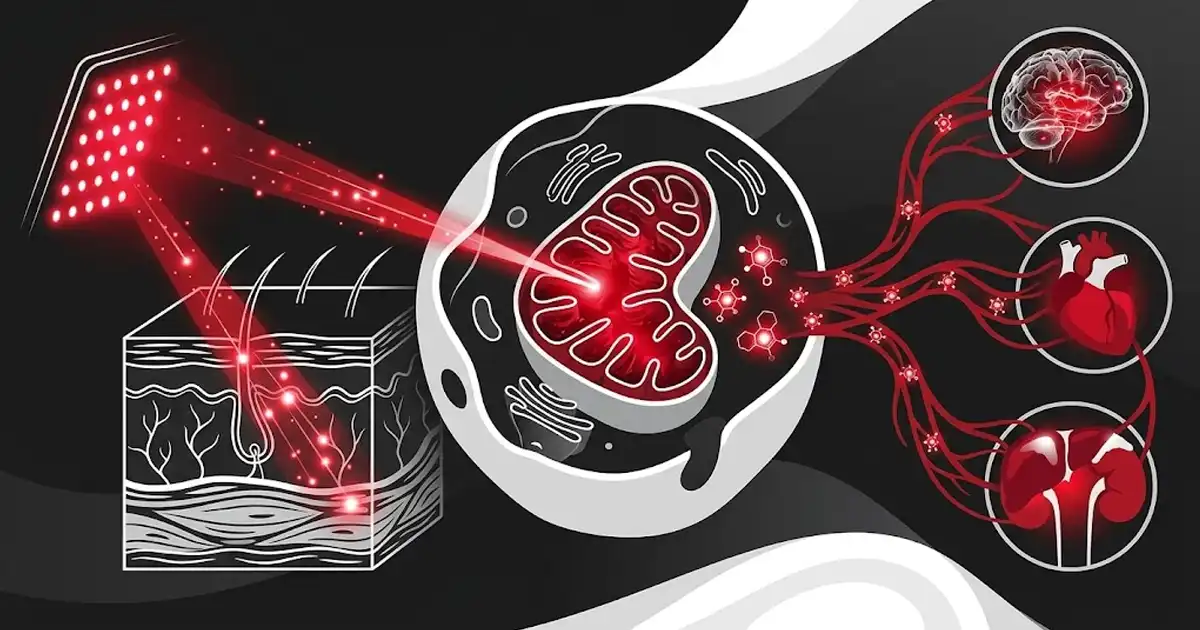
This 2009 review explains why, in photobiomodulation, increasing the light dose does not enhance the effect beyond a certain level. It describes the biphasic dose response and offers explanations based on studies conducted on cells and in animals.
What This Publication Has Contributed
Published in the journal *Dose-Response* by a team from the Wellman Center for Photomedicine, this review addresses a paradox that had been undermining the field’s credibility. For more than forty years, studies have reported that low-level visible or near-infrared light reduces pain, inflammation, and edema; promotes the healing of wounds, deep tissues, and nerves; and prevents cell death and tissue damage. Despite positive results obtained in vitro, in animal models, and in randomized controlled trials, the technique remained controversial in conventional medicine.
The authors offer an explanation for this controversy: the difficulty of making a rational choice among a large number of irradiation parameters. Wavelength, fluence, power density, pulse structure, and treatment timing constitute such a vast range of settings that rigorous studies have yielded both negative and positive results.
Key Points
Several observations form the basis of the authors' argument.
- A biphasic dose response is frequently observed: low levels of light stimulate and repair tissues more effectively than higher levels.
- The Arndt-Schulz curve is the model commonly used to describe this relationship.
- The underlying biochemical mechanisms were not fully understood at the time of publication.
- The parameters involved include wavelength, fluence, power density, pulse structure, and the timing of the treatment.
- The wide variety of these settings explains why there are both positive and negative studies.
- The authors present their own findings, obtained in vitro and in vivo, to support this biphasic response.
How Photobiomodulation Works at the Cellular Level
The journal states that it covers molecular and cellular mechanisms, but its abstract does not specify the pathways involved; therefore, none are cited here on behalf of this article. The key takeaway lies in the shape of the curve. Below a certain threshold, there is too little light to trigger a response. Above an optimum level, the effect does not increase and may even decrease, which clearly distinguishes photobiomodulation from the notion that more energy would necessarily lead to better results.
The explanations proposed by the authors are based on their own research conducted on cells and in animal models. This therefore constitutes a preclinical experimental basis that can be cautiously extrapolated to humans.
Limits You Should Know
The abstract provides neither an optimal fluence value, nor a wavelength, nor a specific threshold: it would be incorrect to use it to determine a dose to be administered. The concept of “optimum” remains qualitative in this text, and this optimum likely depends on the target tissue and the device used.
Furthermore, the Arndt-Schulz curve is a descriptive model derived from the study of hormesis, not a law that has been proven to apply in every situation. Finally, the article was published in 2009, and our understanding of the underlying mechanisms has advanced since then.
Why This Article Is Still Relevant
Because it provided a framework for interpreting failures. Before it, a negative study was often interpreted as evidence of ineffectiveness. After him, it could also be interpreted as a poorly designed study. This distinction has changed the way protocols are designed and how conflicting results are discussed. It is also the text people refer to when arguing that a higher intensity is not necessarily preferable—a point with direct practical implications.
Frequently Asked Questions
What is a biphasic dose response?
It has been observed that a low dose of light stimulates and repairs tissues more effectively than a high dose. The relationship between dose and effect is therefore not linear: it passes through an optimum point, as described by the Arndt-Schulz curve.
Why do some studies on photobiomodulation yield negative results?
The authors highlight the complexity of selecting illumination parameters. Wavelength, fluence, power density, pulse structure, and timing of treatment can lead to inappropriate protocols and, consequently, negative results.
Does a higher dose produce better results?
No, according to this study. Beyond the optimal level, increasing light intensity does not improve tissue repair. However, the abstract does not provide any specific values to determine where this optimal level lies.
Reference
Huang YY, Chen AC, Carroll JD, Hamblin MR. Biphasic dose response in low-level light therapy. Dose-Response, 2009. PMID 20011653. View the study on PubMed
This summary is provided for informational purposes only and does not constitute medical advice. Photobiomodulation is not a substitute for prescribed treatment. Consult a healthcare professional.