Anders J.J. et al. - Photobiomodulation: Adoption of a Unified Term: An Editorial on Nomenclature
This two-page text is a terminological editorial, not a clinical study. In it, the authors note the replacement of the terms “low-level light therapy” and “low-level laser therapy” with the term “photobiomodulation,” which is considered more accurate.
What This Publication Has Contributed
Juanita J. Anders, Raymond J. Lanzafame, and Praveen R. Arany published this article in *Photomedicine and Laser Surgery*, on pages 183 and 184 of Volume 33. It takes the form of an editorial: it contains no description of methods, participants, or results. PubMed does not provide an abstract for it, and the indexing terms associated with the article explicitly list “terminology” as the subject.
Its focus is a vocabulary issue that has become a scientific problem. The term “low-level laser therapy” posed two difficulties. The word “laser” effectively excluded light-emitting diodes, even though they are widely used, and the phrase “low level” has never been given a quantitative definition: no one could say at what power level a treatment ceased to be “low level.” The term “photobiomodulation” circumvents these two pitfalls by describing the phenomenon—a biological modulation induced by light—without prejudging either the source or the energy level.
Key Points
The key takeaways from this text can be summarized in a few points.
- This is a nomenclature editorial, not a clinical trial or a review of mechanisms.
- The title directly contrasts the two categories of treatment: “low-level light/laser therapy” and “photobiomodulation therapy.”
- PubMed does not provide an abstract for this article: no numerical data can be extracted from it.
- The selected indexing terms include low-level light therapy (LLLT) and the term as a subject heading.
- The term "photobiomodulation" is now linked, as an entry term in the MeSH thesaurus, to the descriptor "Low-Level Light Therapy." This information comes from the thesaurus itself, not from the editorial.
- The three authors are well-established figures in the field, which explains the significance of this statement.
How Photobiomodulation Works at the Cellular Level
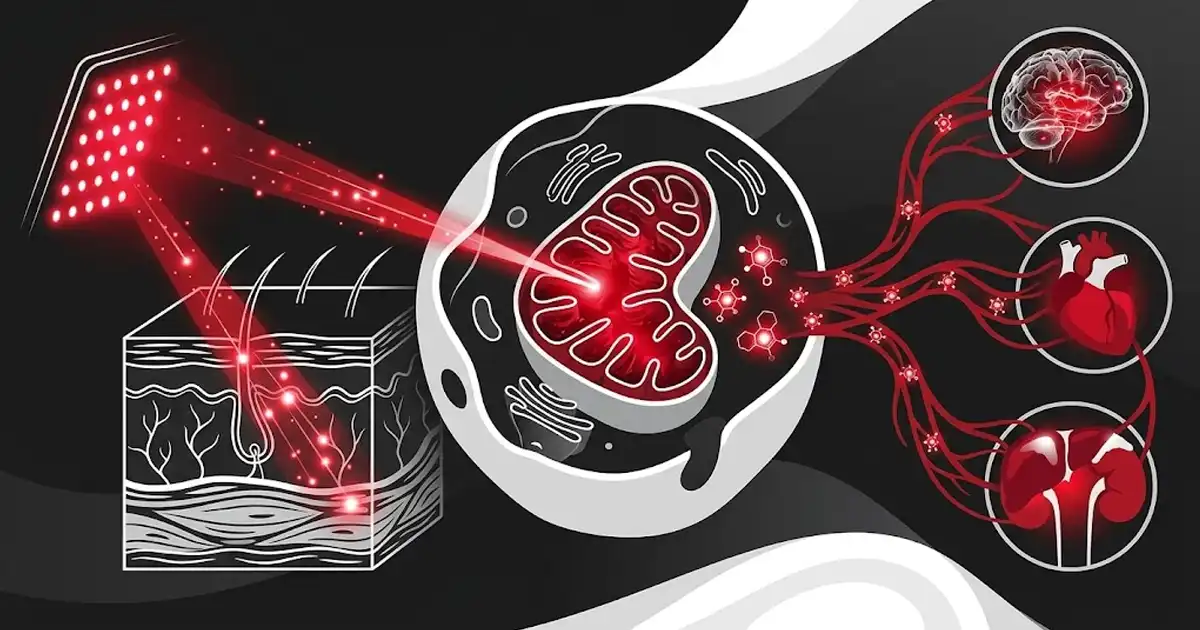
This editorial does not describe any mechanisms and contains no biological data: it would be misleading to attribute a cellular explanation to it. Its contribution is conceptual. By using the term “modulation,” the authors indicate that the expected effect is neither tissue destruction nor heating, but a change in the activity of living cells. The prefix “photo” refers to light as the trigger, without specifying whether it is a laser or a diode.
For information on the mechanisms themselves, one should consult specialized journals, particularly those focusing on light absorption by mitochondria and the biphasic dose response. This research is largely based on experiments conducted on cultured cells and in animal models.
Limits You Should Know
The main limitation is obvious: changing the name does not improve the evidence. Adopting the term “photobiomodulation” makes the terminology more accurate, but it does not make the technique more effective and does not eliminate the need for controlled trials, which remain necessary on a case-by-case basis.
A second limitation is that the lack of a public abstract prevents any detailed analysis of the authors’ reasoning without access to the full text. Finally, PubMed lists only the month and year for this publication—April 2015—without a specific day; the date shown on this record is therefore approximate.
Why This Article Is Still Relevant
Because it marks a definitive shift. After 2015, the scientific literature gradually adopted “photobiomodulation” as the primary term, and the former term became a historical synonym. This standardization has a very concrete effect on literature searches: it allows researchers to find, under a single entry, works that were previously scattered across several competing terms. This text also explains why articles published before and after 2015 do not use the same terms to refer to the same concept.
Frequently Asked Questions
What is the difference between LLLT and photobiomodulation?
These are two names for the same field. “Low-level laser therapy” is the historical term; photobiomodulation is the term that was subsequently adopted because it does not require a laser as the source and does not use the poorly defined concept of “low level.”
Does this article prove the effectiveness of photobiomodulation?
No, and he doesn't claim that. It's a two-page editorial on terminology, with no clinical data. The efficacy is based on controlled trials published elsewhere.
Why was the term "photobiomodulation" chosen?
Because it describes the phenomenon rather than the device: a modulation of biological activity induced by light, regardless of the source, without an implicit energy threshold and without a destructive thermal effect.
Reference
Anders JJ, Lanzafame RJ, Arany PR. Low-level light/laser therapy versus photobiomodulation therapy. Photomedicine and Laser Surgery, 2015. PMID 25844681. View the study on PubMed
This summary is provided for informational purposes only and does not constitute medical advice. Photobiomodulation is not a substitute for prescribed treatment. Consult a healthcare professional.