Chen Y.Y. et al. - Low-intensity red light and choroidal thickness in myopic children: a meta-analysis
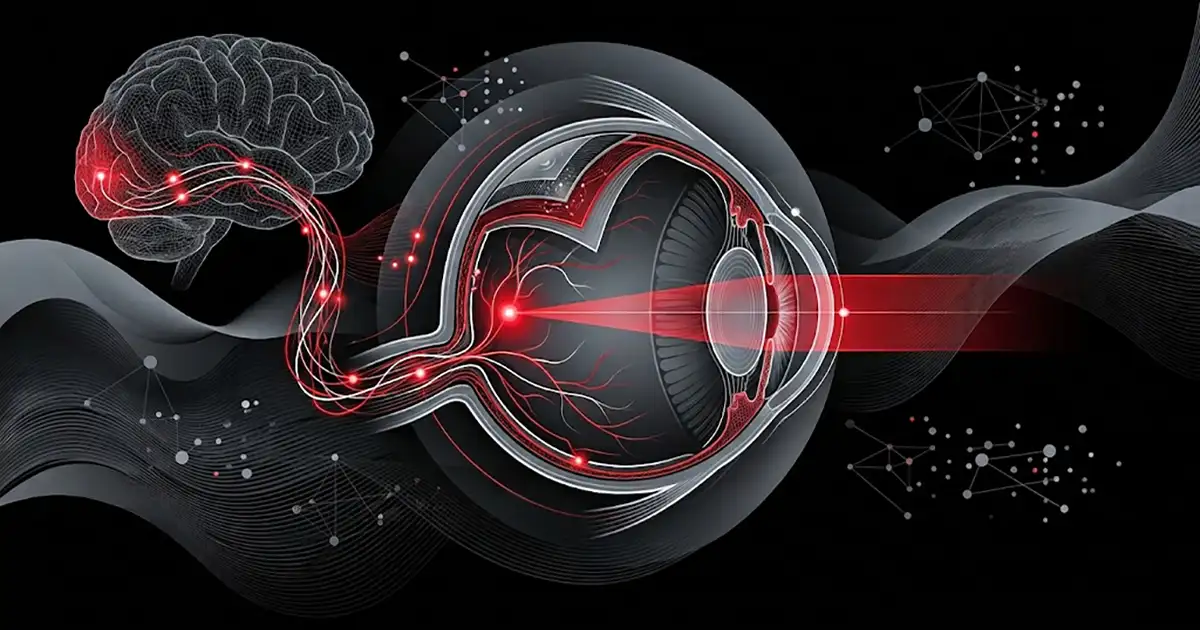
This meta-analysis of 13 randomized trials (1,974 children) reports that repeated low-intensity red light is associated with subfoveal choroidal thickening in myopic children, with a maximum mean difference of 37.01 µm at 9 months. However, the choroid is only an indirect marker: this summary alone does not demonstrate a slowing of myopia.
What this study measured
Repeated low-intensity red light therapy (RLRL) has recently emerged as an approach under study for childhood myopia. Thickening of the choroid—the vascular layer located beneath the retina—has been proposed as one of the biological mechanisms underlying its effect. However, data have remained limited, particularly in children at the premyopic stage, that is, before the onset of established myopia.
The team led by Yu-Yen Chen of the Department of Ophthalmology at Taichung Veterans General Hospital in Taiwan searched PubMed, Embase, and the Cochrane CENTRAL Register for randomized controlled trials comparing RLRL with a control group in participants under 18 years of age. The primary outcome was the change in subfoveal choroidal thickness (SFCT) at 1, 3, 6, 9, and 12 months. Mean differences were pooled using a random-effects model, and subgroup analyses were conducted based on the children’s refractive status.
Key Findings
Thirteen randomized trials, involving 1,974 children, were included. The main findings are as follows.
- Myopic children: a significantly greater increase in SFCT with RLRL than with the control group at all follow-up time points
- Peak at 9 months: average difference of 37.01 µm (95% CI 30.48 to 43.54)
- Children with early-stage myopia: significant thickening of the choroid from 1 to 9 months
- Sensitivity analyses: results confirmed to be robust
- Publication bias: no significant evidence identified
The abstract of the publication does not provide details on the values obtained at other follow-up time points, nor on those observed in children with pre-myopia.
How photobiomodulation works for this indication
The authors note that choroidal thickening has been proposed as a key biological mechanism underlying the efficacy of red light in childhood myopia. This meta-analysis supports this hypothesis, as it demonstrates consistent and reproducible thickening across controlled trials.
However, it measures a change in the choroid, not the growth of the eye itself. The exact relationship between red light, the choroid, and the progression of myopia therefore remains to be clarified. The authors conclude only that these results support further research into the role of choroidal changes in the control of myopia.
Limits You Should Know
SFCT is an indirect measure. The summary of this meta-analysis does not report any effect on the progression of myopia or on axial length; therefore, it does not support the conclusion that red light is clinically effective in treating myopia itself.
The summary also does not specify the level of certainty of the evidence according to the GRADE approach, the characteristics of the devices and sessions used in the trials, or long-term safety. The results pertain to children under 18 years of age and a maximum follow-up of 12 months. They do not address what happens when treatment is discontinued.
What This Means in Practice
For parents of children with myopia, this meta-analysis indicates that repeated low-intensity red light is associated with a measurable thickening of the choroid in controlled trials. It does not provide guidance on selecting a device, dose, or duration of treatment, nor does it replace optical correction or follow-up by an ophthalmologist.
Any use of red light in children should first be discussed with an ophthalmologist, who monitors the progression of myopia and determines the appropriate course of treatment.
Frequently Asked Questions
Does red light cause the choroid to thicken in nearsighted children?
In this meta-analysis of 13 randomized trials, repeated low-intensity red light was associated with greater subfoveal choroidal thickening than in controls, with a maximum of 37.01 µm at 9 months.
Does red light slow the progression of myopia?
This meta-analysis does not directly measure the progression of myopia. Choroidal thickening is an indirect marker: it supports the hypothesis of a mechanism, but is not sufficient to demonstrate a clinical benefit.
Are children with early-stage myopia affected?
The subgroup analysis reported a significant thickening of the choroid between 1 and 9 months in children with pre-myopia. The authors note that evidence in this population remained limited prior to this review.
Reference
Chen YY, Yen HC, Juan KH, et al. Effects of Repeated Low-Level Red-Light Therapy on Subfoveal Choroidal Thickness in Children with Myopia: A Systematic Review and Meta-Analysis. Journal of Clinical Medicine, 2026. PMID 42941377. DOI 10.3390/jcm15207862. View the study on PubMed
This summary is provided for informational purposes only and does not constitute medical advice. Photobiomodulation is not a substitute for prescribed treatment. Consult a healthcare professional.