Karu T.I. et al. - Red and Near-Infrared Light, Nitric Oxide as a Mediator: An In Vitro Experimental Study
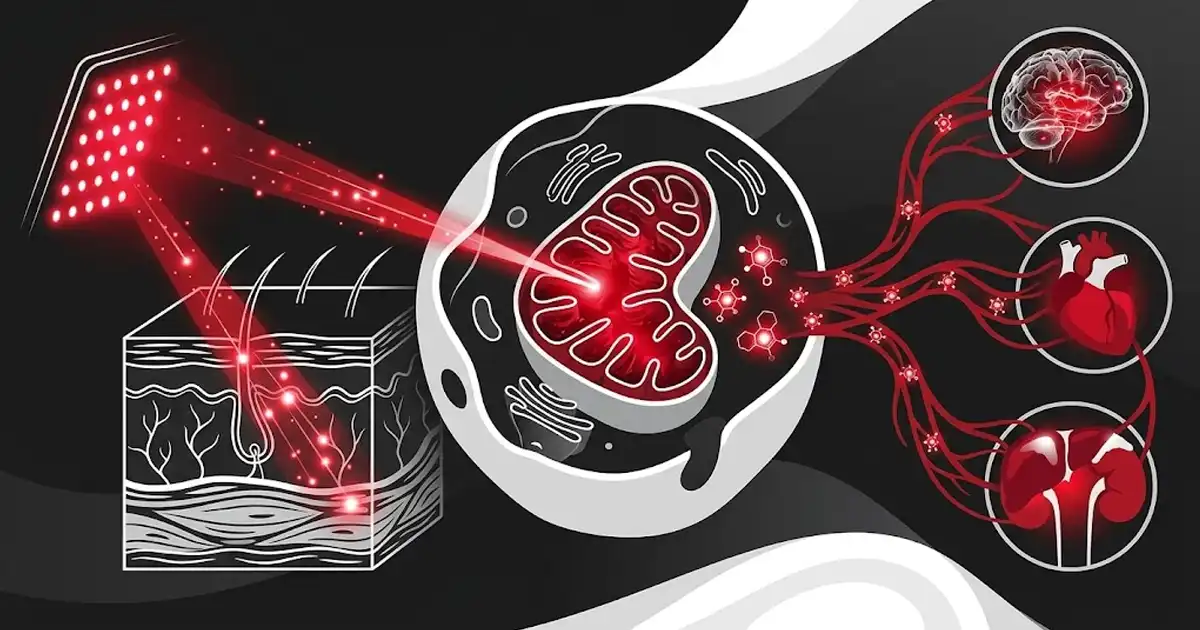
This 2005 study shows that nitric oxide donors added to a suspension of HeLa cells suppress the light-induced increase in cell adhesion and shift the measured spectrum of action. This is an experimental study using cell cultures, not a clinical trial.
What this publication has shown
The stated objective was to test whether nitric oxide, abbreviated as NO, plays a role in the increase in cell adhesion caused by light irradiation. NO is a small gaseous molecule that acts as a signal within and between cells. It can bind to cytochrome c oxidase and inhibit cellular respiration there.
The protocol is based on an indirect but robust measurement: the number of HeLa cells that adhere to a glass substrate after 30 minutes of incubation at 37 degrees. By varying the wavelength, the authors construct an action spectrum—that is, a curve showing at which wavelengths the effect is most pronounced. A well-structured spectrum is a signature: it provides information about the molecule that absorbs the light.
Key Findings
The conditions and values reported are as follows.
- Monochromatic radiation in the visible to near-infrared range: 600–860 nm, 52J/m².
- Laser diode: 820 nm, 8–120J/m².
- Observation of the effect: HeLa cells in suspension adhering to a glass substrate after 30 minutes at 37 degrees.
- Maximum wavelengths in the effective spectrum for increasing adhesion: 619, 657, 675, 740, 760, and 820 nm.
- Tested NO donors: sodium nitroprusside (SNP), glyceryl trinitrate (GTN), and sodium nitrite (NaNO2).
- Concentration range studied: 5 × 10⁻⁹ to 5 × 10⁻⁴ M.
- After treatment with SNP at 5 × 10⁻⁵ M prior to irradiation, the action spectrum is significantly altered, with maxima at 642, 685, 700, 742, 842, and 856 nm.
- NO donors added before irradiation prevent an increase in the number of adherent cells.
- When added after irradiation, NO can also inhibit the light-induced signal downstream.
- Both effects depend on the concentration of NO donors and the fluence.
How Light Affects Mitochondria
The resulting action spectrum, which is well-structured and exhibits multiple maxima, points to the presence of a photoacceptor, believed to be cytochrome c oxidase, the terminal enzyme of the respiratory chain. It also indicates the existence of signaling pathways connecting the mitochondria, the plasma membrane, and the nucleus.
The proposed interpretation is straightforward: by binding to cytochrome c oxidase, NO occupies the binding site and inhibits the light-triggered reaction. The shift in absorption maxima following treatment with SNP is the most compelling evidence: the absorbing molecule is no longer in the same state. The authors conclude that NO can control radiation-activated reactions.
Limits You Should Know
This study involves a laboratory suspension of HeLa cells. No patients are involved, and adhesion to a glass slide is an experimental criterion, not a health-related one. The concentrations of NO donors used are chosen by the researchers and do not replicate living tissue.
The role of NO here is inferred from pharmacological experiments; it has not been observed directly. No therapeutic benefit has been demonstrated. The article dates from 2005: the NO hypothesis has been widely discussed and refined since then, and it remains a hypothesis.
Why This Work Is Considered a Classic
He introduced nitric oxide into the discussion of photobiomodulation, and this idea has remained the prevailing hypothesis to this day: light displaces NO bound to cytochrome c oxidase, thereby removing a brake on cellular respiration. The detailed action spectra published here have since served as a benchmark for selecting the wavelengths to be studied.
Frequently Asked Questions
What is a spectrum of action?
This curve shows the intensity of a biological effect as a function of the wavelength used. Its peaks provide information about the molecule that absorbs the light, much like a fingerprint.
Is nitric oxide a pollutant or a molecule found in the body?
Both exist, but here we are referring to the signaling molecule produced naturally by the body. It plays a role, in particular, in regulating blood vessel diameter and in cellular respiration.
Do these wavelengths define an optimal setting?
No. These are the maximum values measured for a specific cell type, for a specific effect, in a culture dish. They do not constitute a treatment parameter that can be applied to a person.
Reference
Karu TI, Pyatibrat LV, Afanasyeva NI. Cellular effects of low-power laser therapy may be mediated by nitric oxide. Lasers in Surgery and Medicine, 2005. PMID 15739174. View the study on PubMed
This summary is provided for informational purposes only and does not constitute medical advice. Photobiomodulation is not a substitute for prescribed treatment. Consult a healthcare professional.