by Freitas LF et al. - Photobiomodulation and Proposed Mechanisms of Action: A Review of Mechanisms
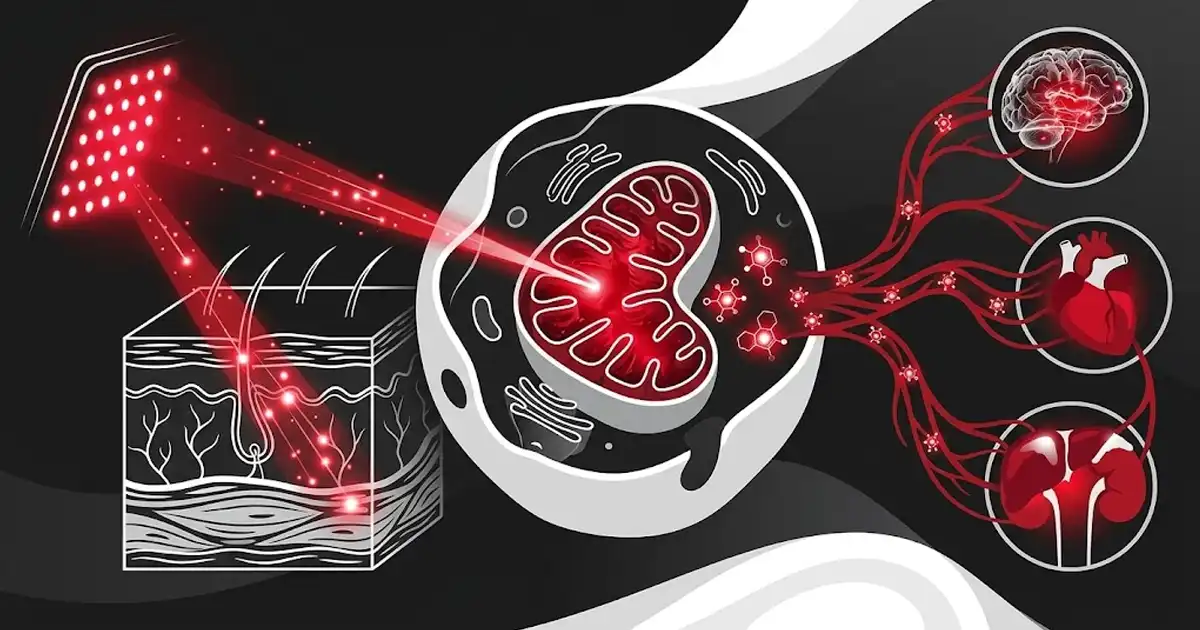
This review summarizes the proposed mechanisms underlying the effects of photobiomodulation, from photon absorption to gene activation. It is a mechanistic review and not a clinical trial.
What This Publication Covers
Photobiomodulation, also known as low-level laser or light therapy, has been known for nearly fifty years but has not gained widespread acceptance, primarily due to uncertainty regarding its molecular, cellular, and tissue-level mechanisms of action. This is the opening observation of this review, published in 2016 and authored by Lucas Freitas de Freitas and Michael R. Hamblin. Its purpose is to summarize the knowledge accumulated in recent years in this field. It is neither a clinical trial nor a meta-analysis: no patients are included, and no efficacy criteria are measured. The text describes a chain of biological events, from photon absorption to changes in gene expression. It is now one of the most frequently cited references for explaining how the technique is thought to work.
The main mechanisms described
The journal distinguishes several levels, from the initial photoreceptor to the long-term effects on the cell.
- Primary chromophore: cytochrome c oxidase, unit IV of the mitochondrial respiratory chain, which contains heme and copper centers and absorbs light in the near-infrared region
- Leading hypothesis: Photons dissociate the inhibitory nitric oxide bound to the enzyme, thereby increasing electron transport, the mitochondrial membrane potential, and ATP production.
- Another hypothesis: the activation of light-sensitive ion channels, allowing calcium to enter the cell
- Signaling pathways subsequently activated: reactive oxygen species, cyclic AMP, nitric oxide, and calcium, leading to the activation of transcription factors
- Reported genetic effects: increased expression of genes involved in protein synthesis, cell migration and proliferation, anti-inflammatory signaling, anti-apoptotic proteins, and antioxidant enzymes
- Stem cells and progenitor cells: described as being particularly sensitive to the technique
Why These Mechanisms Matter
Understanding this cascade is not a theoretical exercise. If the initial effect depends on absorption by a specific chromophore, then the wavelength used is not interchangeable. If the response then involves reactive oxygen species and multiple signaling pathways, then the delivered dose determines the resulting outcome. This logic explains the central role of irradiation parameters in the literature on this subject, and why differing results may be reported when using different devices.
Limits You Should Know
The terminology used by the authors is important: these are hypotheses. The abstract refers to a main hypothesis regarding nitric oxide dissociation and another hypothesis regarding ion channels. Neither is presented as definitively established. Furthermore, these mechanisms are described at the molecular and cellular levels and do not allow for any conclusions regarding clinical benefit for any indication. Finally, the review dates from 2016, and the authors themselves emphasize that knowledge in this field is advancing rapidly.
What This Means in Practice
This publication provides a framework for interpreting clinical trials in this field: without a suitable chromophore or an appropriate dose, there is no reason to expect an effect. It also explains why comparing studies requires examining the parameters before looking at the conclusions. However, it says nothing about what photobiomodulation can offer a specific person in a specific situation. This answer is based on clinical trials and professional opinion.
Frequently Asked Questions
How does light affect cells?
According to the prevailing hypothesis described here, it is absorbed by cytochrome c oxidase in the mitochondria and releases nitric oxide, which inhibits this enzyme. This results in an increase in electron transport, the mitochondrial membrane potential, and ATP production.
Have these mechanisms been proven?
The authors refer to hypotheses rather than established facts. The review summarizes the accumulated knowledge while noting that uncertainty about the mechanisms has long hindered acceptance of the technique.
Does this review prove that photobiomodulation is effective?
No. It is a review of mechanisms, with no patients included and no clinical endpoints measured. Efficacy for a given indication is determined by clinical trials, not by mechanisms.
Reference
de Freitas LF, Hamblin MR. Proposed Mechanisms of Photobiomodulation or Low-Level Light Therapy. IEEE Journal of Selected Topics in Quantum Electronics, 2016. PMID 28070154. View the study on PubMed
This summary is provided for informational purposes only and does not constitute medical advice. Photobiomodulation is not a substitute for prescribed treatment. Consult a healthcare professional.