Karu T.I. - Photobiomodulation: Primary and Secondary Mechanisms—A Literature Review
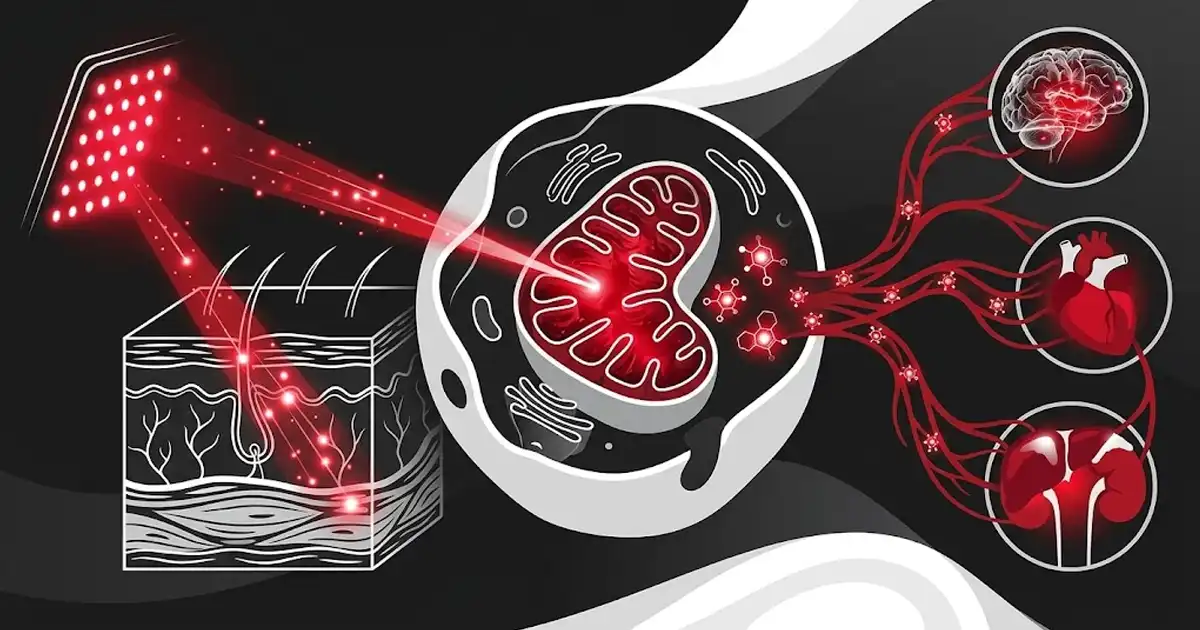
This 1999 review proposes cytochrome c oxidase as a photoacceptor of red and near-infrared radiation within the cell, and distinguishes between the primary mechanisms of absorption and the secondary cascades that follow. This is a review article based on laboratory studies conducted on cells, not a clinical trial.
What this publication has shown
The question posed is both the simplest and the most difficult in the field: when a cell is illuminated with red or near-infrared light, what absorbs that light, and what happens next? Tiina Karu answers this in two parts, and it is this distinction that has made the article so successful.
The first stage involves the primary mechanisms: the photochemical event itself, at the moment a photon is absorbed by a specific molecule. The second stage involves secondary mechanisms—that is, the long series of biochemical reactions triggered within the cell following this initial event. Confusing the two amounts to attributing to light effects that are, in reality, merely the distant consequences of its absorption.
Key Findings
The magazine is organized around a small number of identifiable elements.
- The proposed photoacceptor: cytochrome c oxidase, the terminal enzyme of the respiratory chain.
- The spectral range under consideration: from visible red to the near infrared.
- Four primary mechanisms have been identified.
- Primary 1: Changes in the redox properties of the components of the respiratory chain following photoexcitation of their electronic states.
- Primary 2: Generation of singlet oxygen.
- Primary 3: Transient and localized heating of the absorbing chromophores.
- Step 4: Increased production of superoxide anion, followed by a rise in the concentration of its dismutation product, hydrogen peroxide (H₂O₂).
- Cellular homeostasis parameters involved in secondary mechanisms: intracellular pH (pHi), intracellular calcium ([Ca²⁺]), cyclic AMP (cAMP), redox potential (Eh), and ATP.
This cascade is described as a chain of events involving the transduction and amplification of the light signal: a minor photochemical event gradually leads to much more extensive changes.
How Light Affects Mitochondria
Cytochrome c oxidase is the final enzyme in the respiratory chain, located in the inner membrane of the mitochondrion. It transfers electrons to oxygen, the final step in energy production. It contains copper and iron metal centers that absorb red and near-infrared light; it is this property that makes it a strong candidate for the role of a photoacceptor.
The proposed mechanism is that, upon absorbing a photon, this enzyme undergoes changes in its redox properties. This shifts the operation of the respiratory chain, and the cell detects this shift as changes in its internal pH, calcium levels, or ATP levels.
Limits You Should Know
This is a journal article, not an experiment. It compiles and interprets studies conducted on cultured cells, without any new data and without involving any patients. Cytochrome c oxidase is discussed in the article as a possible photoacceptor, not as a proven photoacceptor.
The text describes a mechanism; it does not demonstrate any therapeutic benefit. Nothing in this review supports the claim that light exposure improves any symptoms in a person. Furthermore, the article dates from 1999: the hypotheses have since been expanded upon and discussed, particularly regarding the role of nitric oxide.
Why This Work Is Considered a Classic
He provided photobiomodulation with its terminology. Before him, publications described effects. After him, they were able to place a result somewhere within a defined causal chain, from the absorbed photon to the cell’s behavior. It is the most frequently cited theoretical framework in the field, and most subsequent work is situated in relation to it.
Frequently Asked Questions
What is cytochrome c oxidase?
It is the final enzyme in the mitochondrial respiratory chain, the one that transfers electrons to oxygen. Its copper and iron centers absorb red and near-infrared light, making it the leading candidate for the role of photoacceptor.
What is the difference between a primary mechanism and a secondary mechanism?
The primary mechanism is the absorption of the photon and the immediate changes it causes in the molecule that absorbed it. The secondary mechanisms are the biochemical reactions triggered subsequently within the cell, sometimes far from the point of origin.
Does this article prove that light has healing properties?
No. It offers an explanation of what happens in a lit cell. A plausible mechanism is not proof of clinical efficacy, which requires trials in patients.
Reference
Karu T. Primary and secondary mechanisms of action of visible to near-infrared radiation on cells. Journal of Photochemistry and Photobiology B: Biology, 1999. PMID 10365442. View the study on PubMed
This summary is provided for informational purposes only and does not constitute medical advice. Photobiomodulation is not a substitute for prescribed treatment. Consult a healthcare professional.