Chung H. et al. - Photobiomodulation, Mechanisms, and Dosimetry: A Comprehensive Review
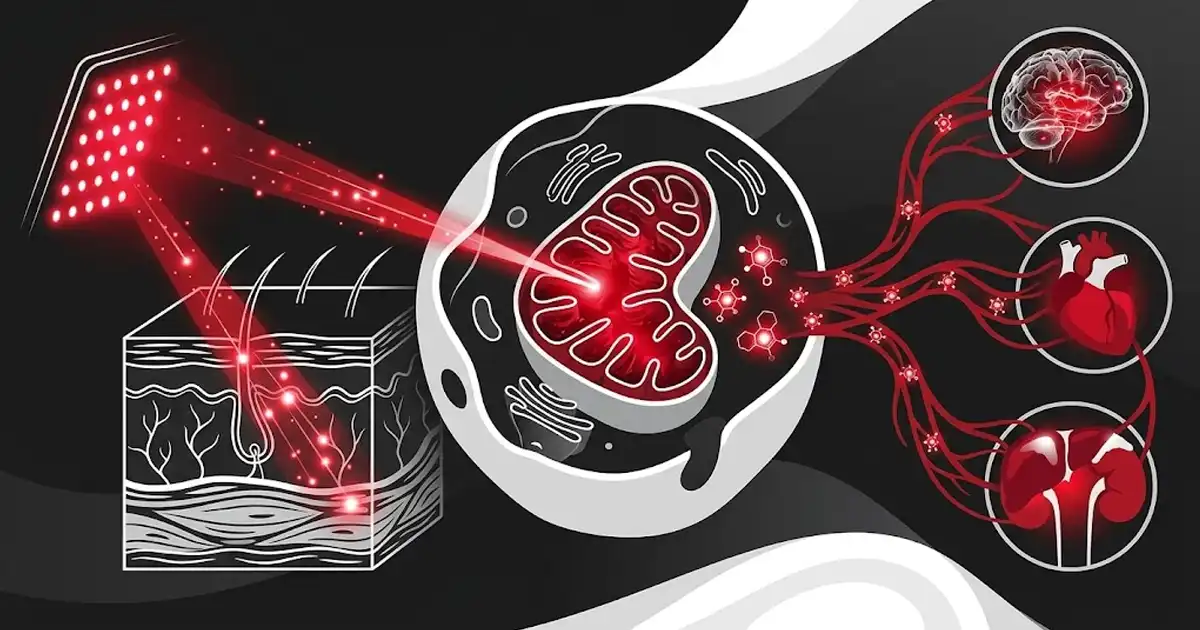
This review, published in 2011, brings together in a single text the cellular and tissue mechanisms of photobiomodulation, the available light sources, and the dosimetry principles used in clinical practice. It describes a field that has long been fragmented, without demonstrating the efficacy of any particular protocol.
What This Publication Has Contributed
Authored by a team from the Wellman Center for Photomedicine at Massachusetts General Hospital, this review was published in *Annals of Biomedical Engineering*. It begins with a historical observation: ever since the invention of lasers in the 1960s, it has been assumed that light could improve wound healing and reduce pain, inflammation, and swelling. Forty years later, knowledge remained scattered across the physics of light sources, cell biology, and clinical trials, with no single text to tie them together.
The main contribution of this article lies in providing a structured overview, from the photon absorbed by the cell to the parameters a practitioner must select. The authors also note a broadening of the field. Initially focused on lasers, it now includes light-emitting diodes and other sources, across a wavelength range that largely covers the red and near-infrared spectrum. The term “photobiomodulation” already appears here, alongside the then-dominant term “low-level laser therapy,” abbreviated as LLLT.
Key Points
The article's abstract highlights several key elements for the field.
- The field is no longer limited to lasers: light-emitting diodes and other light sources are now incorporated into it.
- The wavelengths used are mostly in the red and near-infrared ranges.
- These mechanisms are examined at two levels: the cellular level and the tissue level.
- This document lists the light sources and dosimetry principles used in clinical practice.
- The term LLLT implies a biphasic dose response, as described by the Arndt-Schulz curve.
- The overview of indications gives priority to those that have been the subject of randomized controlled trials.
- Prospects are discussed in the context of serious medical conditions: stroke, heart attack, spinal cord injury, and head trauma.
How Photobiomodulation Works at the Cellular Level
The journal states that it covers mechanisms of action at the cellular and then the tissue level, but its public abstract does not provide specific details. Therefore, no specific molecular pathways will be cited here on behalf of this article. What can be said is that these mechanisms were then largely based on studies conducted on cultured cells and animal models, and that their translation into reproducible clinical effects remains the central issue in the field.
The second level concerns dose. By treating dosimetry as a separate chapter, the authors point out that the same wavelength can produce opposite results depending on the energy delivered and the duration of exposure. It is this idea—formalized by the Arndt-Schulz curve—that explains why rigorous studies sometimes reach contradictory conclusions.
Limits You Should Know
This is a narrative review, not a systematic review with a meta-analysis: the authors select and discuss the literature without quantifying an overall effect. The abstract does not report any efficacy figures, wavelengths, or recommended doses.
The reference to serious conditions is based on a research hypothesis formulated in 2011, not on established findings. Finally, the article is more than ten years old, and the literature has expanded considerably since then, particularly regarding protocols and indications.
Why This Article Is Still Relevant
Its value lies in its role as a gateway. Readers new to the subject will find, presented in a logical order, the history of the field, its proposed mechanisms, its instruments, and its parameters. The article also helped establish two enduring ideas: photobiomodulation does not depend on whether the light is laser-based, and dose is just as important a factor as wavelength.
Frequently Asked Questions
What does “low-level laser therapy” mean?
This is the historical term for photobiomodulation, which was widely used until the 2010s. The authors note that it implies a biphasic dose response: beyond a certain level, increasing the energy does not enhance the effect.
Does this review prove that photobiomodulation is effective as a treatment?
No. It describes mechanisms and lists the indications that have been studied, noting those that have been the subject of randomized controlled trials. A narrative review does not constitute evidence of clinical efficacy.
Do you need a laser, or is an LED enough?
The article specifically notes the expansion of the scope to include light-emitting diodes and other light sources. The abstract does not compare their respective performance.
Reference
Chung H, Dai T, Sharma SK, Huang YY, Carroll JD, Hamblin MR. The nuts and bolts of low-level laser (light) therapy. Annals of Biomedical Engineering, 2011. PMID 22045511. View the study on PubMed
This summary is provided for informational purposes only and does not constitute medical advice. Photobiomodulation is not a substitute for prescribed treatment. Consult a healthcare professional.