Lin L.Y. et al. - Low-intensity red light and myopia in children: a systematic review and meta-analysis
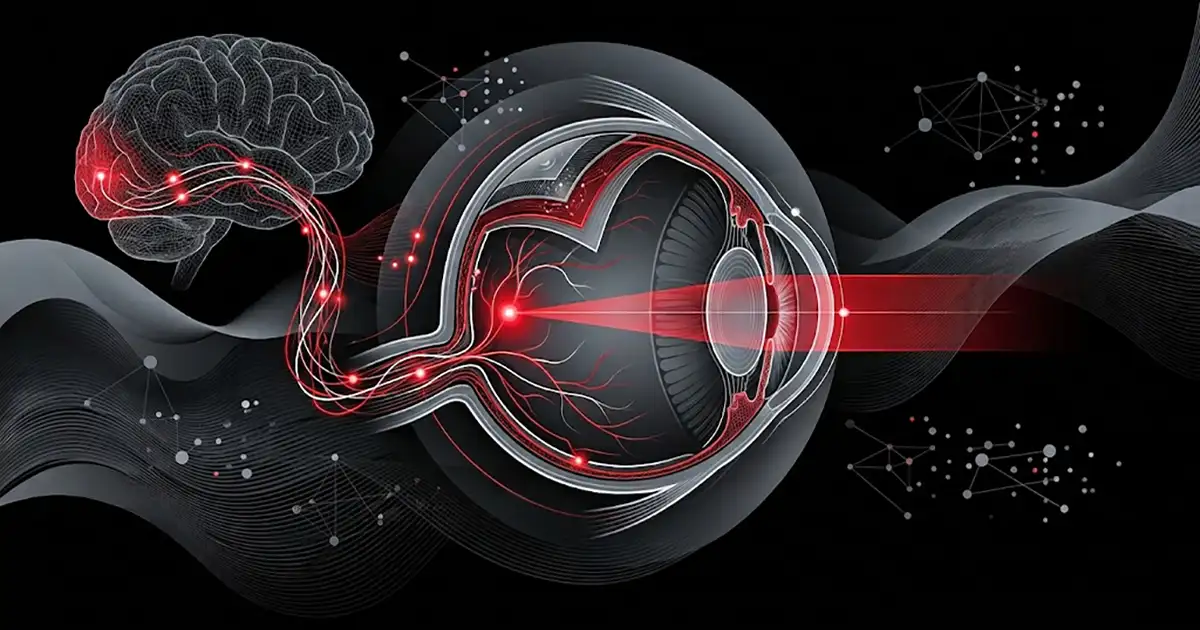
A meta-analysis of 28 randomized trials involving 3,573 children reports that repeated, low-intensity red light therapy, applied directly to the eye, slows the progression of myopia over the course of one year. The effect increases with the duration of treatment, but long-term retinal safety has not been established.
What this study measured
Repeated low-intensity red light therapy (RLRL) is a photobiomodulation device designed for pediatric ophthalmology: the child stares at a red light source during short, repeated sessions several days a week. The team led by Lee-Yuan Lin (Taipei Medical University) assessed its efficacy and safety based solely on randomized controlled trials. PubMed, Embase, and the Cochrane Library were searched through August 2025 for studies involving children under 18 years of age. The primary outcome was the spherical equivalent of refraction; secondary outcomes included axial length of the eye, choroidal thickness, and visual acuity. Twenty-eight trials and 3,573 participants were included; certainty was assessed using the GRADE approach, under the PROSPERO protocol CRD420251112677.
Key Findings
The authors describe myopia control that depends on the duration of treatment. Anterior segment parameters remained stable.
- Refraction (spherical equivalent) at 12 months: +0.68 diopters compared to the baseline
- Axial length at 12 months: -0.30 mm compared to the control group
- Choroidal thickness at 12 months: +26.7 micrometers
- Effet dépendant de la durée du traitement (p < 0,05)
- Bénéfice plus marqué chez les enfants les plus myopes au départ (p < 0,0001)
- 5- and 7-day-a-week regimens: comparable effects
- Higher uncorrected visual acuity; anterior chamber, cornea, and lens unchanged
- Mild and transient adverse effects, with no persistent structural or functional abnormalities
How photobiomodulation works for this indication
The proposed explanation remains hypothetical. Red light is thought to be absorbed by the retina and the choroid—particularly by mitochondrial cytochrome c oxidase—which would locally increase ATP production and alter choroidal vascular tone. The choroidal thickening measured here is the most commonly cited marker: a thicker choroid could slow the elongation of the eyeball, a central mechanism in progressive myopia. None of these measures were assessed in the included trials.
Limits You Should Know
Key point: These results cannot be applied to photobiomodulation used on the skin or the entire body. This is an ophthalmic device intended for use on the eye, which requires specialized monitoring and must never be improvised using a consumer-grade device. The certainty of the evidence is moderate for refraction and choroidal thickness, but lower for axial length—despite the fact that axial length is the most relevant parameter in the long term. Follow-up did not exceed one year, and the authors call for longer trials with comprehensive retinal evaluation: long-term safety remains unclear. Finally, a large proportion of the trials originated in East Asia, which limits the generalizability of the findings.
What This Means in Practice
These data confirm that repeated red light therapy is among the options discussed in pediatric ophthalmology, alongside low-dose atropine and defocusing glasses or contact lenses. The decision, the device, and retinal monitoring are the responsibility of an ophthalmologist. The abstract indicates that treatments administered 5 and 7 days per week yield comparable results, but does not specify the wavelength, intensity, or duration of the sessions.
Frequently Asked Questions
Does red light really slow the progression of myopia in children?
In this meta-analysis of 28 randomized trials involving 3,573 children, it is associated with a difference of +0.68 diopters and -0.30 mm in axial length at 12 months. The certainty of evidence is moderate for refraction, lower for axial length, and data beyond one year are lacking.
Can a standard red light therapy device be used on the eyes?
No. These results pertain to a medical device designed for ophthalmology, with validated parameters and specialized monitoring. A device intended for use on the skin does not offer the same guarantees of ocular safety, and staring at an intense light source without supervision poses a risk to the retina.
Is this treatment safe for children's eyes?
The reported adverse effects are described as mild and transient, with no persistent structural or functional abnormalities. However, the follow-up period rarely exceeds one year, and the authors call for longer trials. Long-term safety has not been established, which warrants regular ophthalmological follow-up.
Reference
Lin LY, Hsu CH, Su H, Sun JW, Wu JS, Jeng WJ, Tsai CH, Yuliani FS, Lin SH. Duration-Dependent Efficacy and Clinical Safety of Repeated Low-Level Red-Light Therapy for Pediatric Myopia: A Systematic Review and Meta-Analysis. Clinical & Experimental Ophthalmology, 2026. PMID 41846466. View the study on PubMed
This summary is provided for informational purposes only and does not constitute medical advice. Photobiomodulation is not a substitute for prescribed treatment. Consult a healthcare professional.