Mester E. et al. - Inhibitory and Activating Effects of Laser Beams: A Surgical Report from 1968
Published in 1968 in a German-language surgical journal, this article is commonly cited as one of the first to articulate both the inhibitory and activating effects of the laser beam. PubMed does not provide an abstract for it: this entry outlines its significance without attributing any specific findings to it.
The Context of the Time
In the late 1960s, the medical applications of the laser were still being explored. Two schools of thought coexisted. The first, which was dominant, viewed the beam as a tool for controlled destruction—to remove a lesion or coagulate tissue. The second, which was marginal, posited that low-level exposure might, on the contrary, promote certain biological processes. Contemporary journals report that Endre Mester’s team in Budapest stumbled upon this second line of research by accident: while investigating whether the ruby laser caused cancer in mice, they observed no tumors but instead noticed faster regrowth of shaved fur and accelerated wound healing.
It’s also important to remember how articles were published back then: short articles written in the journal’s language, and bibliographic databases that did not yet include abstracts. PubMed published virtually none of them before 1975, and this article is no exception.
What This Publication Is About
Here is the complete text of what can be verified in the package insert, without any reconstruction on our part.
- Exact title as indexed: [Studies on the inhibiting and activating effects of laser beams].
- Journal: Langenbecks Archiv für Chirurgie, abbreviated as Langenbecks Arch Chir, volume 322, pages 1022–1027.
- Year of publication: 1968. No month or day is listed in the record.
- Authors: Mester E, Ludány G, Sellyei M, Szende B, Gyenes G, Tota GJ.
- Language of publication: German. DOI: 10.1007/BF02453990.
- MeSH Index Terms: Animals, Ehrlich Carcinoma, Hair, Humans, Lasers, Leukocytes, Mice, Phagocytosis, Skin, Wound Healing.
This index is the most comprehensive of the four foundational publications selected here: animals and humans, skin, hair, wound healing, leukocytes, and phagocytosis. It illustrates the breadth of the topics covered, without providing any information about the protocol or the direction of the effects.
What We Know Today About the Mechanism
A concept often associated with the title of this article is that of a biphasic dose response: moderate exposure may stimulate an activity that higher exposures no longer enhance, or may even inhibit. This idea was formalized well after 1968 and cannot be attributed to this text.
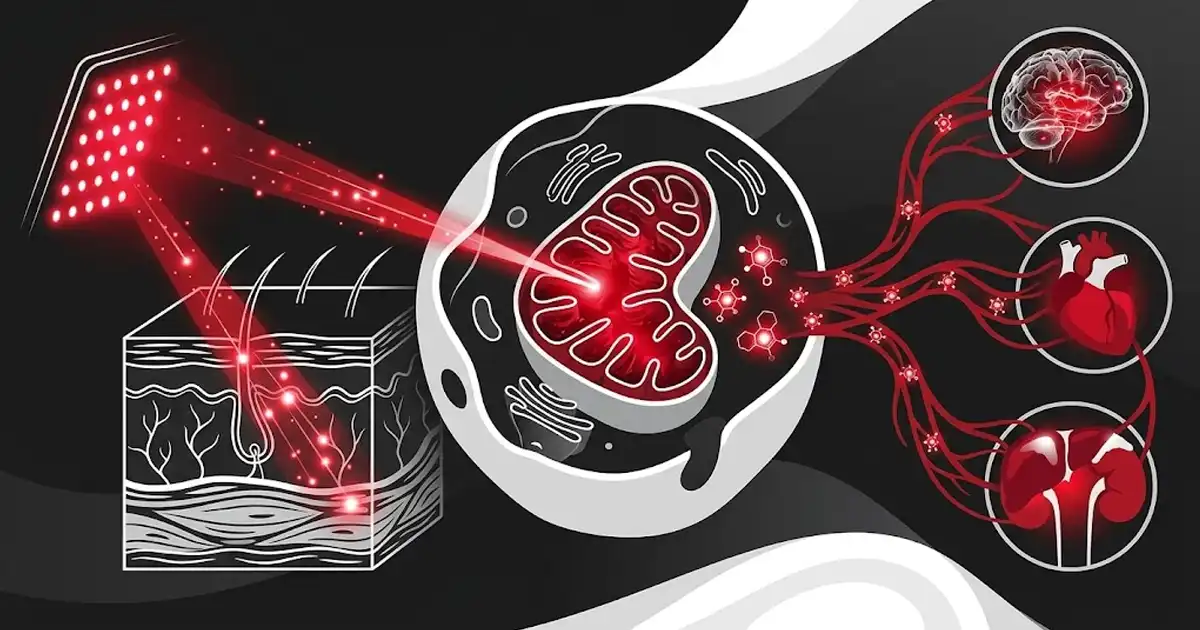
The most widely studied cellular model involves the absorption of red and near-infrared light by mitochondrial cytochrome c oxidase, followed by signaling involving reactive oxygen species and calcium. None of this framework was available to the authors in 1968.
What This Fact Sheet Cannot Tell You
Let’s be clear. PubMed does not provide an abstract for this article, so no numerical data can be reported here. We do not know how many animals or subjects were studied, at what doses, at what wavelength, for how long, or what the magnitude of the effect was.
Nor can we confirm that a control group was established, nor describe the measurements that were taken. The methods used in 1968 do not meet current standards for randomization, blinding, and statistical analysis. Finally, the full text is in German and is not freely available.
Its place in the history of photobiomodulation
This work is usually presented as the point at which the Budapest team broadened its inquiry beyond the mouse’s fur. Its value lies in this thematic expansion, not in its evidential strength. The current assessment of photobiomodulation is based on subsequent, controlled, and well-documented trials.
Frequently Asked Questions
The title refers to inhibition: can light slow something down?
The indexed title does indeed mention both directions. In the absence of an abstract, it is impossible to know exactly what the authors meant by this, or what the described inhibition pertained to.
Why does the term "Humans" appear in the index?
MeSH terms describe the topics covered in the article. Their presence indicates that a human aspect is addressed somewhere in the text, without specifying whether it involved clinical observations, cells, or simply a discussion.
Why does the date shown say January 1, 1968?
The entry lists only the year. January 1 is a notation specific to this record and does not represent the actual publication date.
Reference
Mester E, Ludány G, Sellyei M, Szende B, Gyenes G, Tota GJ. [Studies on the inhibitory and stimulatory effects of laser beams]. Langenbecks Arch Chir, 1968, 322, 1022-7. PMID 5758676. View the record on PubMed
This summary is provided for informational purposes only and does not constitute medical advice. Photobiomodulation is not a substitute for prescribed treatment. Consult a healthcare professional.