Mester E. - Biostimulative Effect of Laser Therapy in 259 Patients: A Clinical Series
In 1982, Endre Mester published the only one of his earlier studies to provide clinical data: a series of 259 patients with impaired wound healing. He reported therapeutic success in more than 90% of them, with an average treatment duration of 10 to 12 weeks.
The Context of the Time
Fifteen years after his discovery in 1967, Endre Mester had accumulated considerable clinical experience in Budapest with wounds that do not heal: leg ulcers, pressure sores, areas of necrosis, and various skin disorders. This article, published in German in a journal of experimental surgery, summarizes that experience.
It is important to remember that, at that time, randomized, double-blind clinical trials were not yet the gold standard in surgery. A case series reported by an experienced team was an accepted form of publication. That is precisely the format of this article.
What This Publication Covers
The abstract available on PubMed is brief and provides only a few figures, which are reproduced here verbatim.
- The biostimulatory effect of laser radiation was first established in animal studies.
- It was subsequently observed in 259 patients with impaired wound healing.
- The treatment was considered a success in more than 90% of patients.
- The average duration of treatment was 10 to 12 weeks.
- The author states that laser therapy can be safely administered to patients.
The abstract does not specify any wavelength, power, dose, or session frequency. Nor does it mention any control group. Therefore, these details cannot be specified here.
What We Know Today About the Mechanism
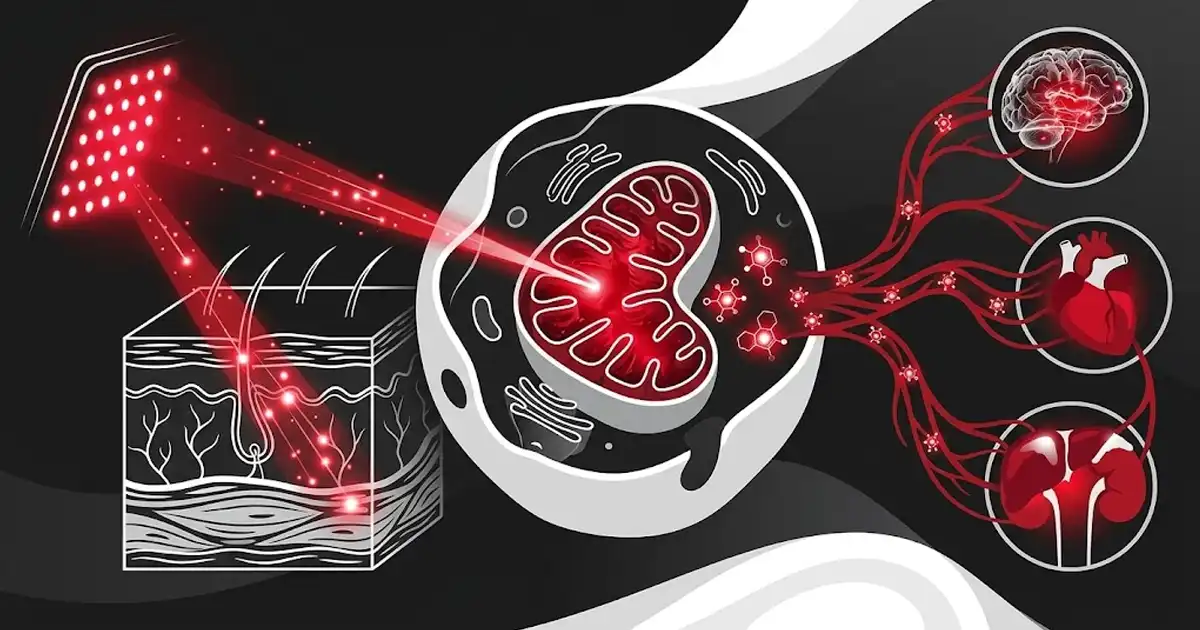
Delayed wound healing involves persistent inflammation, inadequate microcirculation, and reduced fibroblast activity. The current understanding of photobiomodulation is based on the absorption of red and near-infrared light by cellular chromophores, particularly mitochondrial cytochrome c oxidase, with effects on cellular energy production, signaling via reactive oxygen species, and fibroblast migration.
These mechanistic pathways are consistent with what Mester described, but they were formalized long after his time, beginning in the 1990s and 2000s.
Limits You Should Know
This figure of over 90% is the most frequently cited and most misunderstood aspect of Mester’s work. It comes from a series of patients treated by a single team, without randomization, without blinding, and without a control group documented in the abstract. The criteria defining success are not specified. Patient selection is not described. Under these conditions, a high response rate may reflect the natural healing process of certain wounds, the quality of associated care, or the patient’s expectations just as much as the light’s specific effect.
Added to this is the complete lack of irradiation parameters, which makes the experiment irreproducible. This 1982 finding is therefore not proof of efficacy as we understand it today, and the assertion that there is no risk is based on a team’s observation, not on a structured safety assessment.
Its place in the history of photobiomodulation
This article served as a benchmark: it provided clinicians in the 1980s with a rough estimate and a plausible treatment duration for a specific indication. It helped steer research toward chronic wounds, which remain one of the most extensively studied areas in the discipline today. Its value is historical and directional rather than conclusive.
Frequently Asked Questions
What does “impaired healing” mean in this article?
The abstract does not define the term. The keywords associated with the publication refer to wounds, necrosis, skin conditions, and psoriasis. These are therefore likely to be a variety of conditions, which makes it difficult to interpret the series as a whole.
Is a rate of over 90% achievable today?
No. It comes from an uncontrolled study conducted in 1982 and cannot be used to predict an individual outcome. Modern evaluations of photobiomodulation for chronic wounds report more moderate effects that are highly dependent on specific parameters.
Why 10 to 12 weeks of treatment?
This is the average duration reported by the author for this series. It reflects difficult wounds that were monitored over several months, not a standardized protocol that has been validated elsewhere.
Reference
Mester E. [Biostimulating effect of laser beams]. Z Exp Chir, 1982. PMID 7090465. View the study on PubMed
This summary is provided for informational purposes only and does not constitute medical advice. Photobiomodulation is not a substitute for prescribed treatment. Consult a healthcare professional.