Mester E. et al. - Effect of laser beams on hair growth in mice: a seminal 1968 article
Published in 1968 in a German journal of radiobiology, this article is commonly cited as one of the very first studies on the effect of a laser beam on hair growth in mice. PubMed does not provide an abstract for it: this entry describes its historical significance but does not report any of its findings.
The Context of the Time
The ruby laser was developed in the early 1960s. In the decade that followed, medical teams were more concerned with safety than with potential benefits: Could such a concentrated beam of light damage tissue or even promote the growth of tumors? Contemporary journals report that Endre Mester, a surgeon in Budapest, addressed the issue in 1967 from this perspective, exposing shaved mice to a laser beam to investigate the potential induction of cancer. According to the account cited in the literature review, he observed no tumors but did note faster hair regrowth in the exposed animals and accelerated wound healing. This episode is recognized as the starting point of the field.
Scientific publishing during this period worked differently than it does today: articles were brief, often written in the journal’s language, and bibliographic databases did not yet include abstracts. PubMed published virtually none of them before 1975, and this article is no exception.
What This Publication Is About
The only verifiable information in the entry is bibliographic. Here it is, without any extrapolation.
- Exact title as indexed: [The effect of laser beams on hair growth in mice].
- Journal: Radiobiologia, Radiotherapia, abbreviated as Radiobiol Radiother (Berl), Volume 9, Issue 5, pages 621–626.
- Year of publication: 1968. No month or day is listed in the record.
- Authors: Mester E, Szende B, Gärtner P.
- Language of publication: German.
- MeSH Index Terms: Animals, Hair, Lasers, Male, Mice.
- Document type: original article. No DOI is associated with this record.
These terms confirm the context: an animal study—conducted on male mice—examining hair and laser exposure. They do not provide details on the method, exposure parameters, or results.
What We Know Today About the Mechanism
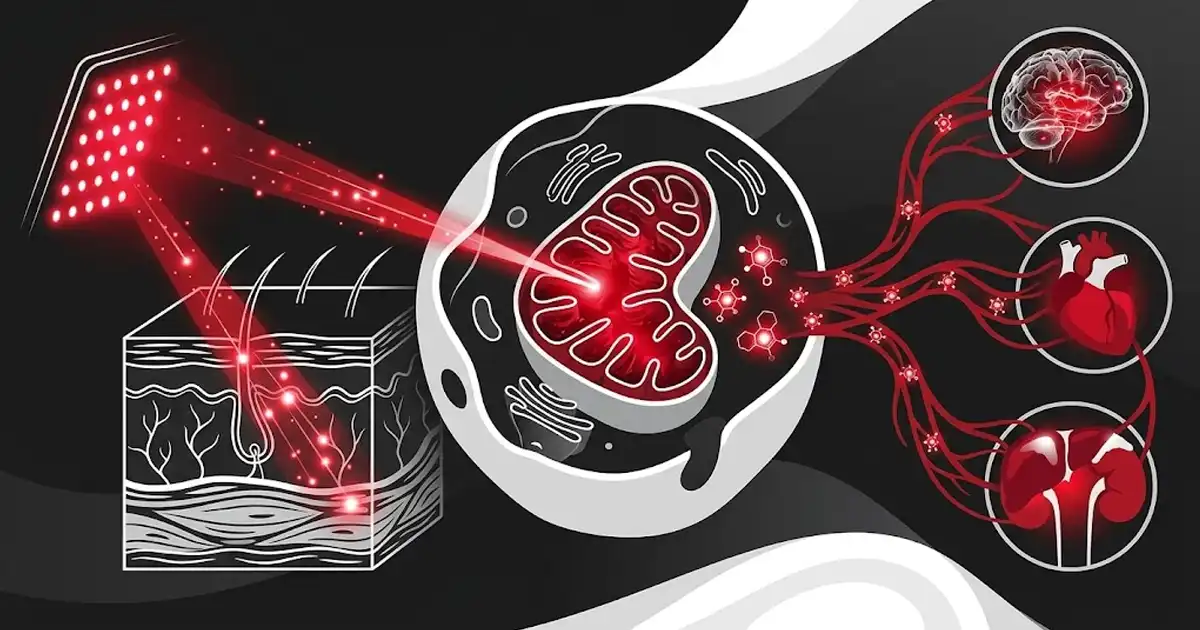
The explanation that is most widely discussed today dates from several decades later and therefore cannot be attributed to this text. Modern research suggests that red and near-infrared light is absorbed by intracellular chromophores, foremost among which is mitochondrial cytochrome c oxidase, which would then trigger a signaling pathway involving reactive oxygen species and calcium.
Other avenues are being explored, notably photosensitive ion channels. None have been ruled out. The 1968 article should therefore be read for what it is: an early observation, predating this conceptual framework.
What This Fact Sheet Cannot Tell You
The limitation is clear. PubMed does not provide an abstract for this article; therefore, no numerical data can be reported here. We cannot specify the number of animals, the duration of follow-up, the wavelength, the dose, or the magnitude of any effect.
There are three additional caveats. The abstract does not document any control group, making it impossible to confirm its existence. The methods used in the late 1960s do not meet current standards for randomization, blinding, and statistical analysis. Finally, the text is in German and is not freely accessible.
Its place in the history of photobiomodulation
This work is commonly regarded as the birth of a new field of research. Its value lies in its historical significance rather than its scientific proof: it marks the moment when an unexpected observation was deemed worthy of publication. The current assessment of photobiomodulation is based on much later, controlled, and carefully calibrated protocols, not on this text.
Frequently Asked Questions
Why doesn't this article have an abstract on PubMed?
PubMed has systematically indexed abstracts only since the mid-1970s. Earlier records are limited to the title, authors, journal, and indexing terms.
Can we say that Mester proved something in 1968?
No, not based on this document. The account of accelerated regrowth comes from later historical journals, not from a verifiable finding here.
Why does the date shown say January 1, 1968?
Only the year is listed in the entry. January 1 is a standard display date used for this entry, not the actual publication date.
Reference
Mester E, Szende B, Gärtner P. [The effect of laser beams on hair growth in mice]. Radiobiol Radiother (Berl), 1968, 9(5), 621-6. PMID 5732466. View the record on PubMed
This summary is provided for informational purposes only and does not constitute medical advice. Photobiomodulation is not a substitute for prescribed treatment. Consult a healthcare professional.