Karu T.I. - Photobiomodulation and Cytochrome c Oxidase: An Experimental Study Using Cell Cultures
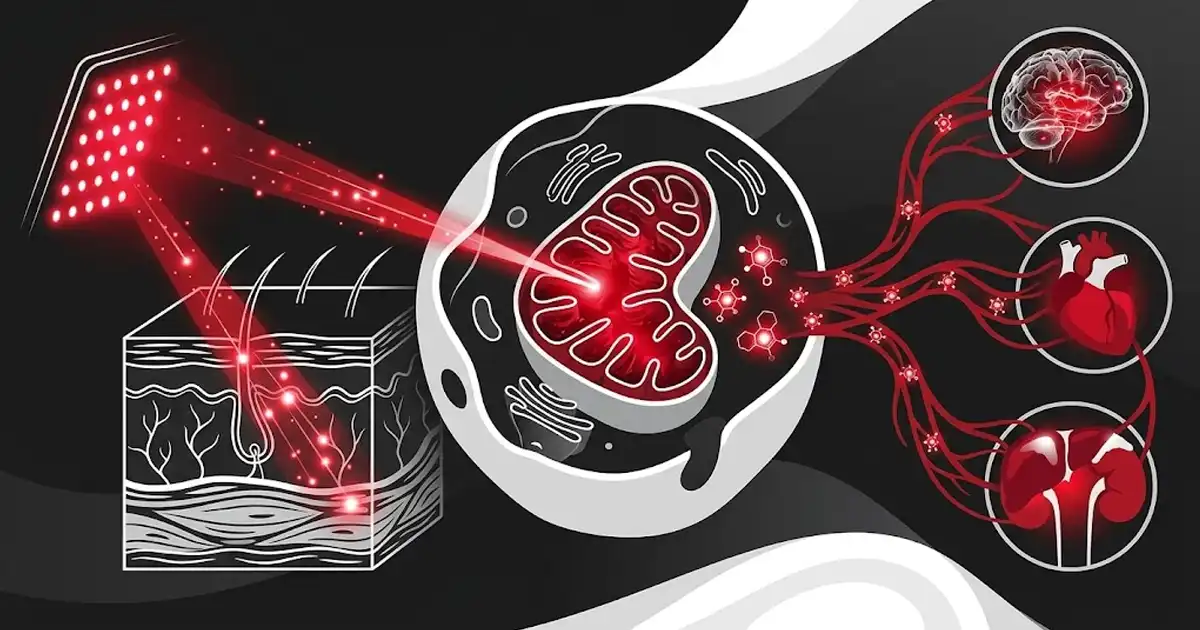
This laboratory study measured the absorption spectrum of human cells in culture and observed that illumination at 830 nm alters the redox state of cytochrome c oxidase. This is a cell-based experiment, not a clinical trial: it sheds light on a mechanism but does not demonstrate any benefit for patients.
What this publication has shown
Phototherapy uses monochromatic light in the 600–1,000 nm wavelength range. The prevailing hypothesis in the early 2000s was that this light exerts its effect because it is absorbed by cytochrome c oxidase, the final enzyme in the mitochondrial respiratory chain—the series of reactions that transfers electrons to oxygen and enables the cell to produce energy. The hypothesis was plausible, but the evidence remained indirect.
This study tests this hypothesis through measurement. It records the absorption spectra of monolayers of HeLa cells placed under different oxygenation conditions, observes how they change after irradiation at 830 nm—a wavelength frequently used in phototherapy—and then compares them to known action spectra. An action spectrum relates each wavelength to the intensity of the biological response it elicits: if the molecule that absorbs the light is the one that triggers the effect, the two curves should resemble each other.
Key Findings
The measurements distinguish between two regions of the spectrum, associated with two chemical states of the molecule that absorbs light, known as the photoacceptor.
- The 710–790 nm region is characteristic of a relatively small photoacceptor.
- The 650–680 nm region is characteristic of a relatively oxidized photoacceptor.
- The ratio of the peaks at 760 and 665 nm serves as an indicator of the redox state of cytochrome c oxidase.
- According to this criterion, irradiating single-layer cells at 830 nm, at a dose of 6.3 × 10³ J/m², causes the photoacceptor to be reduced.
- The peaks at 616, 665, 760, 813, and 830 nm in the absorption spectra show similarities to the action spectra of long-term cellular responses.
- These long-term responses are an increase in the rate of DNA synthesis and cell adhesion to a matrix.
How Light Affects Mitochondria
Cytochrome c oxidase contains copper and iron atoms that exist in two forms—oxidized or reduced—depending on whether they have donated or accepted electrons. These two forms do not absorb light in the same way, as reflected by the two spectral regions identified here. Measuring the ratio between the peaks at 760 and 665 nm is equivalent to determining the redox state of the enzyme in living cells.
The key finding is that exposure to 830 nm shifts this equilibrium toward the reduced form: the light is not merely absorbed; it alters the enzyme’s state. What happens between this change and any potential clinical improvement is not discussed.
Limits You Should Know
The model consists of a human cell line cultured in a monolayer, which is very different from living, vascularized tissue. No animals, no volunteers, and no patients are involved: there are no clinical criteria, no follow-up, and no measured benefits.
The optical conditions in a culture dish are not the same as those on the skin. The dose used is specific to this study and says nothing about other energy levels, and the similarity between spectra remains merely a correlation. Finally, this publication is more than twenty years old: our understanding has evolved, and cytochrome c oxidase is no longer considered the only possible target.
Why This Work Is Considered a Classic
Before Tiina Karu, a Russian physicist, the effect of red light was based solely on empirical observation. This work provides a direct measurement, using whole cells, of the state of the molecule believed to absorb light. It transforms a hypothesis into spectroscopic data and provides peak positions that have been replicated by other research teams.
Frequently Asked Questions
What is cytochrome c oxidase, in simple terms?
It is the final enzyme in the respiratory chain, the mitochondria's energy production pathway. It contains copper and iron, which enable it to absorb red and near-infrared light.
Does this study prove that red light has healing properties?
No. It describes a mechanism observed in cultured cells and does not measure any effect on pain, a wound, or a disease.
Why is the 830 nm wavelength used here?
Because it was already commonly used in phototherapy. The authors wanted to determine what effect a specific wavelength has on the enzyme.
Reference
Karu TI, Pyatibrat LV, Kolyakov SF, Afanasyeva NI. Absorption measurements of a cell monolayer relevant to phototherapy: reduction of cytochrome c oxidase under near-infrared radiation. Journal of Photochemistry and Photobiology B: Biology, 2005;81(2):98-106. PMID 16125966. View the study on PubMed
This summary is provided for informational purposes only and does not constitute medical advice. Photobiomodulation is not a substitute for prescribed treatment. Consult a healthcare professional.