Mester E. et al. - The Effect of Laser Beams on Wound Healing: A 1971 Article in an International Surgical Journal
Published in October 1971 in the *American Journal of Surgery*, this article is commonly cited as the moment when Hungarian research on lasers and wound healing crossed the borders of the Eastern Bloc. PubMed does not provide an abstract for it; this entry describes its historical significance but does not attribute any specific findings to it.
The Context of the Time
Between 1968 and 1971, the publications by Endre Mester’s team appeared in German or Hungarian in regional journals. Their readership remained limited. Contemporary journals report that the 1971 publication in a widely read American surgical journal changed this situation and brought the subject to the attention of teams that had not had access to it until then.
At that time, the laser was primarily viewed as a cutting or coagulation tool, and the idea that light exposure promotes tissue repair remained a minority view. Editorial conventions did not help: PubMed indexes virtually no abstracts from before 1975, with the result that the entry still contains no summary text even today.
What This Publication Is About
Here is what the instructions make it possible to determine with certainty—and nothing more.
- Exact title as indexed: Effect of laser rays on wound healing.
- Journal: American Journal of Surgery, abbreviated as Am J Surg, volume 122, issue 4, pages 532–535.
- Publication date: October 1971. The specific day is not listed in the record.
- Authors: Mester E, Spiry T, Szende B, Tota JG.
- Language of publication: English. DOI: 10.1016/0002-9610(71)90482-x.
- MeSH Index Terms: Animals, Burns, Electrocoagulation, Female, Lasers, Male, Mice, Radiation Effects, Skin, Wound Healing, Wounds and Injuries.
Two points are worth noting without overinterpreting them: the use of English, which distinguishes this article from previous ones, and an index that combines the terms “burns,” “wounds,” “electrocoagulation,” and “effects of radiation” in mice. This defines a topic, not a result.
What We Know Today About the Mechanism
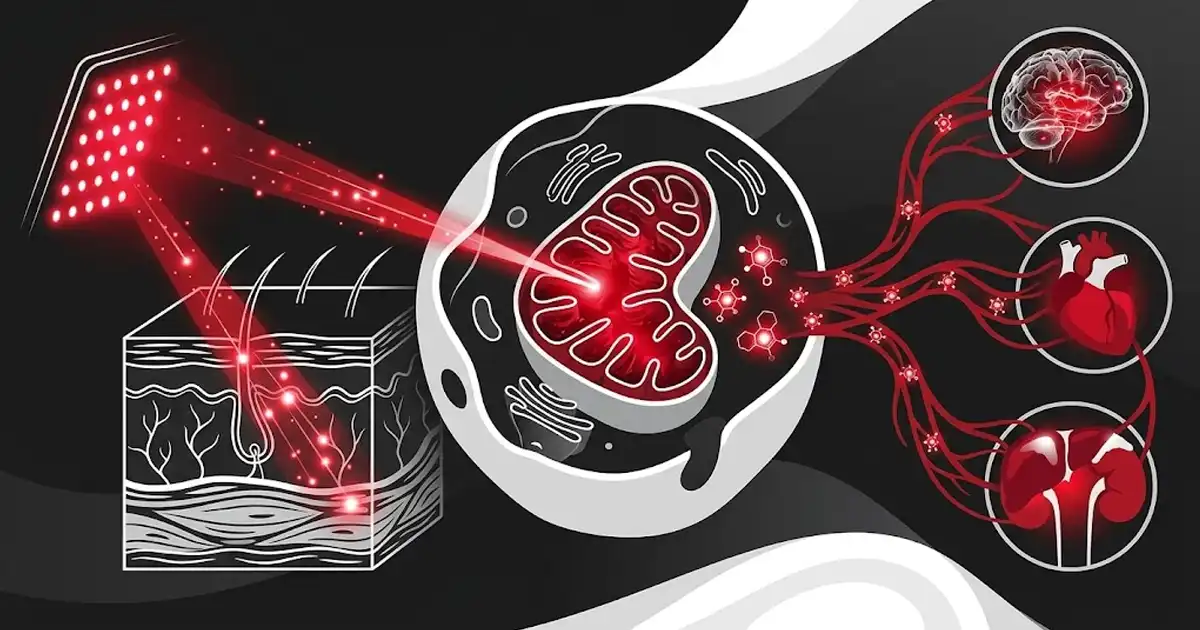
The explanations put forward today date from several decades after the publication of that article. The most widely studied model posits that photons are absorbed by mitochondrial cytochrome c oxidase, followed by changes in energy metabolism and signaling involving reactive oxygen species and calcium fluxes.
When applied to skin repair, this framework is used to discuss fibroblast migration, matrix synthesis, and the regulation of local inflammation. These studies are contemporary and should not be confused with the content of the 1971 article, which remains unavailable for reading through this channel.
What This Fact Sheet Cannot Tell You
The limitation must be stated clearly. PubMed does not provide an abstract for this article, so no specific data can be reported here. We do not know the number of animals included, the exact type of lesion, the wavelength and dose used, the frequency of sessions, the duration of follow-up, or the magnitude of any reported differences.
Nor can we confirm that a control group was present, nor can we describe the method used to assess healing. Research practices in the early 1970s do not meet current standards for randomization, blinding, and statistical analysis. This fact sheet should therefore in no way be interpreted as evidence of efficacy.
Its place in the history of photobiomodulation
This text plays a pivotal role in the history of the field: it is cited as the point at which the subject entered the international surgical literature. Its significance lies in its role as a milestone in the dissemination of knowledge. The data on which current discussions of wound healing are based come from much later trials, conducted using documented protocols and published parameters.
Frequently Asked Questions
Does this article prove that lasers speed up healing?
This entry does not provide sufficient evidence to support that claim. In the absence of an accessible abstract, no results can be verified or reported. The article’s historical significance does not constitute proof.
Why is publishing in English considered important?
This is because the team’s previous publications were in German or Hungarian, in journals with limited circulation. Historical journals cite this American publication as the factor that brought international attention to the subject.
Why is the date shown as October 1, 1971?
The notice specifies the month and year, but not the day. The first of the month is a formatting convention specific to this record.
Reference
Mester E, Spiry T, Szende B, Tota JG. Effect of laser rays on wound healing. Am J Surg, 1971, 122(4), 532-5. PMID 5098661. View the record on PubMed
This summary is provided for informational purposes only and does not constitute medical advice. Photobiomodulation is not a substitute for prescribed treatment. Consult a healthcare professional.