Mester E. et al. - Wound Healing and Immunocompetent Cells: An Experimental Study
In 1978, Endre Mester and his colleagues directly irradiated human lymphocytes to understand why laser light appeared to accelerate wound healing. They described an immunosuppressive effect and varying efficacy depending on the wavelength used.
The Context of the Time
Endre Mester, a surgeon in Budapest, had observed in 1967 that a low-power laser applied to the skin of animals could accelerate wound healing. This effect, which was unexpected at the time, remained unexplained from a biological standpoint. Throughout the 1970s, his team published a series of papers titled “Stimulation of wound healing by means of laser rays,” the third installment of which sought to identify a mechanism rather than describe a clinical outcome.
The question is simple: if light accelerates tissue repair, does it affect the cells of the immune system? At a time when cellular immunology was booming, this line of inquiry made a great deal of sense.
What This Publication Covers
The authors directly exposed human lymphocytes to laser radiation and observed their response. The findings reported in the abstract are as follows.
- The immunosuppressive effect of laser radiation was studied in human lymphocytes that were directly irradiated.
- The ionized argon gas laser proved to be more effective in the range between 488 and 501 nm than at other wavelengths.
- At the same performance level, this argon laser has also proven to be more efficient than the 632-nm helium-neon laser.
- The authors hypothesize that the suppression of an undesirable immune response—described as an autoaggressive process—contributes to the laser’s stimulating effect on wound healing.
The summary does not specify the doses administered, the duration of exposure, or the number of samples analyzed. Therefore, this information cannot be included here.
What We Know Today About the Mechanism
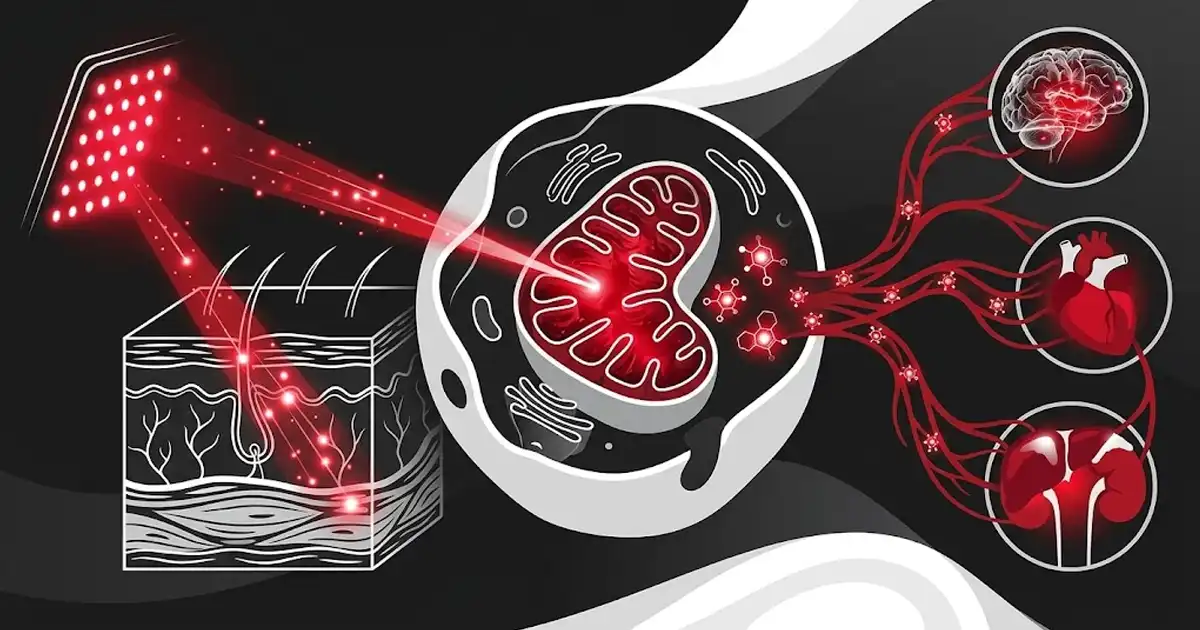
Mester’s immunological hypothesis was not accepted as the primary explanation. The current understanding favors the absorption of red and near-infrared light by cellular chromophores, foremost among which is cytochrome c oxidase in the mitochondrial respiratory chain, as well as certain light-sensitive ion channels. This absorption alters cellular energy production and signaling via reactive oxygen species and calcium.
The idea that light modulates the activity of immune cells has not disappeared, however: the modulation of inflammation remains one of the current areas of research. But we no longer speak of immunosuppression in the sense intended by the 1978 article.
Limits You Should Know
This study is nearly fifty years old and should be read as such. The available abstract does not specify the irradiation parameters, which makes the experiment irreproducible as it stands. These are observations conducted on isolated cells, with no demonstrated connection to what occurs in a human wound. No control group or statistical analysis is described in the abstract, and the sample size is not specified.
Finally, the authors themselves present the conclusion regarding the role of the self-aggressive process as a hypothesis. These limitations do not detract from the historical value of the work, but they preclude drawing any therapeutic conclusions from it today.
Its place in the history of photobiomodulation
This article marks a turning point: Mester no longer merely observes an effect; he seeks its cause at the cellular level. It is also one of the first papers to explicitly compare several wavelengths—an approach that has become central to the field. Contemporary photobiomodulation is based precisely on the idea that the biological response depends on the wavelength and the dose received.
Frequently Asked Questions
Does laser treatment weaken the immune system?
This article describes an immunosuppressive effect observed in lymphocytes isolated in the laboratory. This does not mean that a photobiomodulation session weakens a person’s immune system. No such conclusion can be drawn from this study.
Why compare argon lasers and helium-neon lasers?
These two sources were the main ones actually available in laboratories in the 1970s. Argon emits blue and green light, while helium-neon emits red light. Comparing them was tantamount to testing whether the color of light mattered.
Are these results still being used?
They are cited for their historical significance and for the questions they raise, not as evidence of effectiveness. Current practices are based on much more recent and much better-documented controlled trials.
Reference
Mester E, Nagylucskay S, Tisza S, Mester A. Stimulation of wound healing by laser rays. Part III—Investigation of the effect on immune-competent cells. Acta Chir Acad Sci Hung, 1978. PMID 735645. View the study on PubMed
This summary is provided for informational purposes only and does not constitute medical advice. Photobiomodulation is not a substitute for prescribed treatment. Consult a healthcare professional.