Karu T.I. et al. - Helium-neon laser and increased cellular ATP: an in vitro experimental study
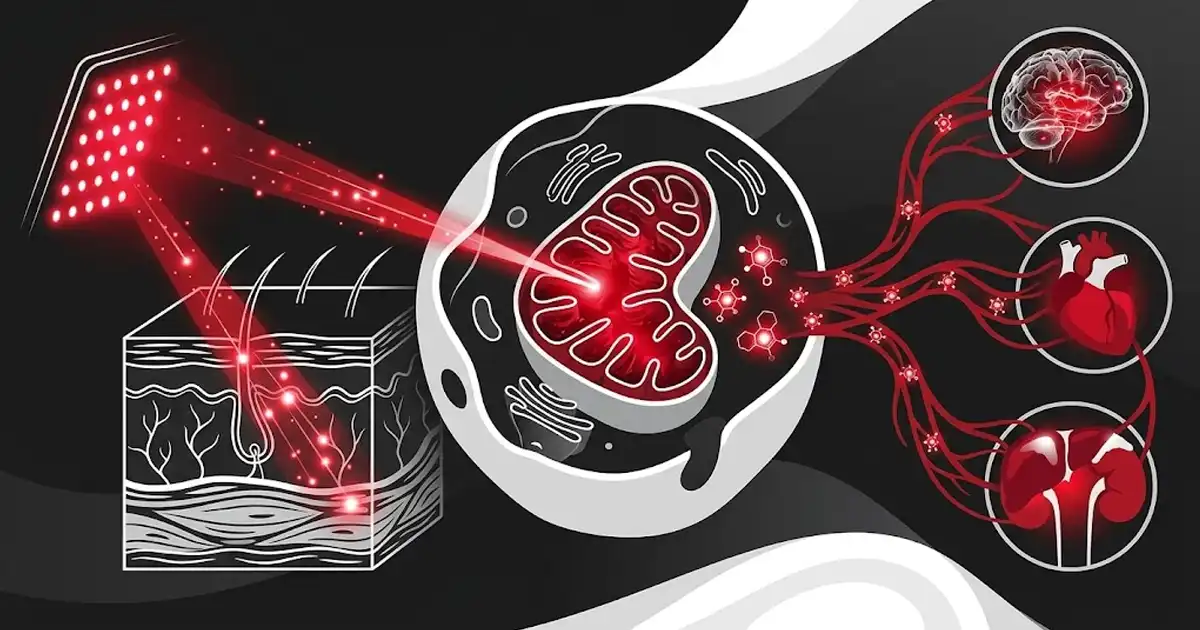
This 1995 publication reports that exposure to a helium-neon laser at 632.8 nm transiently increases the amount of adenosine triphosphate measured in HeLa cells cultured in the laboratory. This is an experimental study using cell cultures, not a clinical trial in humans.
What this publication has shown
Prior to this study, the effect of red light on living cells had been observed but not explained. Tiina Karu, a Russian physicist, was looking for a measurable indicator capable of linking light exposure to an objective cellular response. She chose ATP, or adenosine triphosphate, the molecule that serves as the energy currency for all our cells: it is produced by the mitochondria and consumed whenever a cell works, divides, or repairs itself.
The principle behind the experiment is simple. A monolayer of HeLa cells—a human laboratory cell line—was irradiated with a helium-neon laser. The amount of ATP was then measured at various time points using the luciferin-luciferase bioluminescence technique, which emits light in the presence of ATP.
Key Findings
The values reported in the article are as follows.
- Wavelength used: 632.8 nm, that of the helium-neon laser.
- Dose delivered: 100J/m², over a 10-second exposure period.
- Measurements taken between 5 and 45 minutes after irradiation.
- Reference level in the log phase: 0.79 ± 0.09 × 10⁻¹⁵ mol per cell.
- No changes were observed during the first 15 minutes following irradiation.
- Peak ATP level 20 minutes after irradiation, at 170.8% of the control level.
- A slow return to the control level following this peak.
- Maximum response of approximately 190% for cells at the end of the logarithmic phase and the beginning of the plateau phase.
- Negligible effect on cells in the latency phase.
The last point is just as important as the peak itself: the response depends on the state of the cells at the time of exposure. The same light, when shone on the same cells, does not produce the same effect depending on their stage of growth.
How Light Affects Mitochondria
The mitochondrion is the cellular compartment where ATP is produced through a series of reactions known as the respiratory chain. Tiina Karu’s hypothesis is that certain components of this chain absorb red and near-infrared light, and that this absorption alters their function. A measurable increase in ATP following irradiation supports this interpretation, as it places the mitochondria at the center of the response.
This publication alone does not demonstrate the mechanism in question. It provides the missing link between light exposure and a quantifiable metabolic change.
Limits You Should Know
This is a laboratory study using cultured cells. No patients, no living tissue, and no clinical trials are involved. Furthermore, HeLa cells are an immortalized cancer cell line whose metabolism does not reflect that of a typical human cell in its original tissue.
The observed change is temporary and returns to the initial level. Nothing in this study supports the claim that light exposure relieves pain, accelerates healing, or improves symptoms in a person. Finally, the article dates from 1995: our understanding of the mechanisms of photobiomodulation has advanced significantly since then.
Why This Work Is Considered a Classic
He introduced a quantitative measure where previously there had been only an observation. By linking a specific wavelength, dose, and time interval to a quantified change in an energy marker, he made the phenomenon studyable by other research teams. The protocol is reproducible, and ATP measurement has since become a standard criterion in research on photobiomodulation.
Frequently Asked Questions
What exactly is ATP?
Adenosine triphosphate is the molecule that transports energy within cells. Mitochondria produce it, and the cell uses it for virtually all of its activities. Its level therefore provides an indication of current metabolic activity.
Is a helium-neon laser the same thing as a red LED?
No. The helium-neon laser emits coherent light with a very narrow wavelength at 632.8 nm. An LED emits light over a broader spectrum and lacks coherence. The results obtained with one cannot be directly applied to the other.
Does this study demonstrate a health benefit?
No. It describes a biochemical change in cells in culture dishes. An effect measured in vitro does not in any way imply a benefit for a person, which would require clinical trials.
Reference
Karu T, Pyatibrat L, Kalendo G. Irradiation with a He-Ne laser increases ATP levels in cells cultured in vitro. Journal of Photochemistry and Photobiology B: Biology, 1995. PMID 7769534. View the study on PubMed
This summary is provided for informational purposes only and does not constitute medical advice. Photobiomodulation is not a substitute for prescribed treatment. Consult a healthcare professional.