Photobiomodulation Research Update - April 2026
A scientific publication scheduled for April 2026
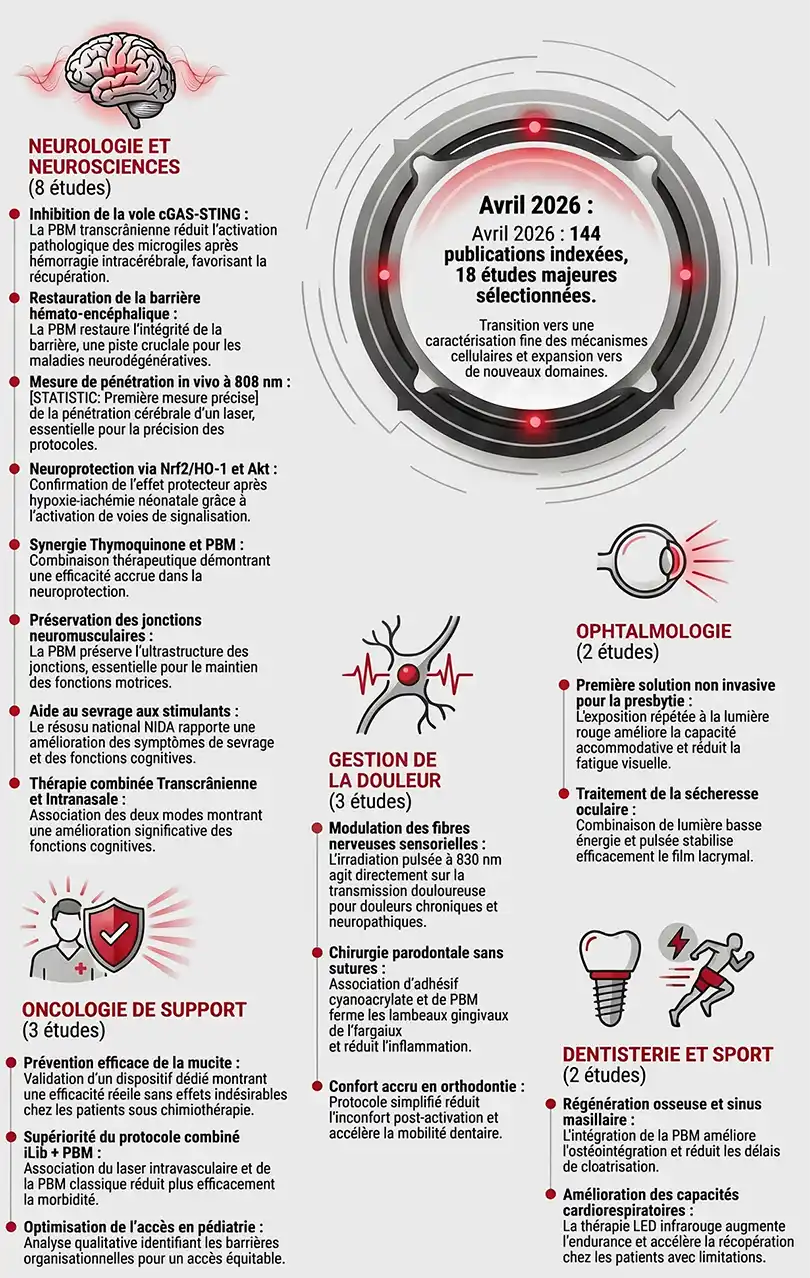
April 2026 confirms the momentum in photobiomodulation (PBM) research. A total of 144 publications were indexed on PubMed (94 under the term “photobiomodulation” and 50 under “low-level laser/light therapy”).
After removing duplicates and filtering for studies with clinical relevance, we selected 18 particularly significant studies. They cover six major areas: supportive care in oncology, neurology and neuroscience, ophthalmology, dentistry, sports and recovery, and pain management.
This selection highlights the growing maturity of PBM as a non-invasive therapeutic tool and the steady expansion of its clinical indications.
At Bioledtherapy, we closely monitor this research to guide the development of our whole-body photobiomodulation solutions. Here are the key takeaways from April 2026.
Neurology and Neuroscience: 8 Landmark Studies
Neurology remains the most dynamic field in April 2026, with eight major publications. The research focuses on both the mechanisms of action and the clinical applications of transcranial magnetic stimulation (TMS).
Du et al. (Chinese Medical Journal) demonstrate a novel mechanism: transcranial PBM reduces pathological microglial activation by inhibiting the cGAS-STING pathway following intracerebral hemorrhage, thereby improving neurological recovery (DOI).
Verkhratsky and colleagues (The Journal of Physiology) have shown that PBM restores the integrity of the blood-brain barrier, opening up new possibilities for the treatment of neurodegenerative diseases (DOI).
In terms of quantification, Wang et al. (Lasers in Surgery and Medicine) provide the first precise measurement of the in vivo penetration of an 808-nm laser into the brain, a critical piece of data for optimizing clinical protocols (DOI).
Liu et al. (Behavioral and Brain Functions) confirm the neuroprotective effect of low-level laser therapy following neonatal hypoxia-ischemia via the Nrf2/HO-1 and Akt pathways (DOI).
Several studies are exploring combination therapies. Woźniak-Mitał et al. (Neurology and Therapy) combine transcranial PBM with intranasal therapy, resulting in improved cognitive function (DOI).
Jaz et al. (Metabolic Brain Disease) demonstrate a synergistic effect between thymoquinone and transcranial PBM in neuroprotection (DOI).
Vasyagina et al. (Cells) provide a morphological analysis: PBM preserves the ultrastructure of neuromuscular junctions (DOI).
Finally, Kittirattanapaiboon et al. (Journal of Substance Use and Addiction Treatment) have published the results of the NIDA national network on the use of PBM in stimulant withdrawal, showing improvements in withdrawal symptoms and cognitive function (DOI).
Supportive Oncology: 3 Landmark Clinical Trials
Supportive oncology remains a key area for PBM, with three studies that reinforce current practices.
Maguluri et al. (JMIR Biomedical Engineering) have published a clinical trial evaluating the efficacy and safety of a PBM device designed to prevent and treat mucositis in patients undergoing chemotherapy. The results confirm the treatment’s efficacy without any major adverse effects (DOI).
Do Nascimento et al. (Head & Neck) demonstrate that combining intravascular laser therapy (iLib) with PBM results in superior efficacy in the management of oral mucositis, thereby reducing the morbidity associated with cancer treatment (DOI).
Heggie and colleagues (Pediatric Blood & Cancer) have published a qualitative analysis focusing on the implementation of PBM in pediatric oncology. The study identifies organizational barriers and proposes strategies to improve equitable access to these treatments (DOI).
Pain Management: 3 Validated Protocols
Three studies have contributed to our understanding of the analgesic effects of PBM.
Takeuchi et al. (Lasers in Surgery and Medicine) elucidate the mechanism of action of 830-nm pulsed laser irradiation on the modulation of pain transmission in sensory nerve fibers, paving the way for non-pharmacological protocols for chronic and neuropathic pain (DOI).
Sharma et al. (Lasers in Surgery and Medicine) propose an innovative approach in periodontal surgery: combining a cyanoacrylate adhesive with PBM to close gingival flaps without sutures, resulting in a significant reduction in postoperative inflammation (DOI).
Santos et al. (Dental Press Journal of Orthodontics) have published a simplified protocol for PBM in orthodontics, which significantly reduces post-activation discomfort and accelerates tooth movement (DOI).
Ophthalmology: 2 Breakthroughs in Eye Strain
Two studies explore the use of red light to treat common eye conditions.
Song and colleagues (Annals of Medicine) have published a randomized, double-blind clinical trial demonstrating that repeated exposure to red light improves visual fatigue and enhances accommodative ability in presbyopic patients.
This is the first conclusive demonstration of an effective non-invasive optical intervention for presbyopia (DOI).
Kharuhayothin and colleagues (The Ocular Surface) evaluated the combination of low-level light therapy and intense pulsed light to stabilize the tear film in patients with dry eye caused by computer use. The reduction in symptoms was significant (DOI).
Dentistry and Periodontology: 1 study on bone regeneration
Dominiak et al. (Journal of Functional Biomaterials) demonstrate that incorporating PBM into maxillary sinus augmentation protocols significantly improves bone regeneration, promotes osseointegration, and shortens healing times (DOI).
Sports and Recovery: 1 Study on Cardiorespiratory Function
Pereira et al. (Respiratory Medicine) demonstrate that infrared LED therapy improves cardiorespiratory parameters in patients with functional limitations. The benefits include improved endurance and accelerated recovery after exercise (DOI).
These findings underscore the growing interest in PBM for sports recovery protocols and respiratory rehabilitation.
What this means for clinical practice
Three key findings emerge from this April 2026 review. First, transcranial PBM has reached a milestone with the detailed characterization of its mechanisms of action (cGAS-STING, Nrf2/HO-1) and the quantification of tissue penetration.
Next, supportive oncology is consolidating its practices, with a particular focus on organizational implementation and equitable access. Finally, ophthalmology is emerging as a promising field thanks to randomized trials on presbyopia and eye strain.
For healthcare professionals, this data strengthens the evidence base essential for integrating PBM into patient care pathways. For individuals and athletes, it confirms the safety and wide range of benefits of this therapy. You can find all our solutions in our online store, or try the Body Boost Bed full-body bed at one of our partner centers.
Literature search conducted using the PubMed and MEDLINE databases. Editorial selection: Bioledtherapy team. Publication date: May 1, 2026.
See also
Our News
Similar articles, tips, and discoveries